≡ Menu

A Getting Back to Normal Roundup

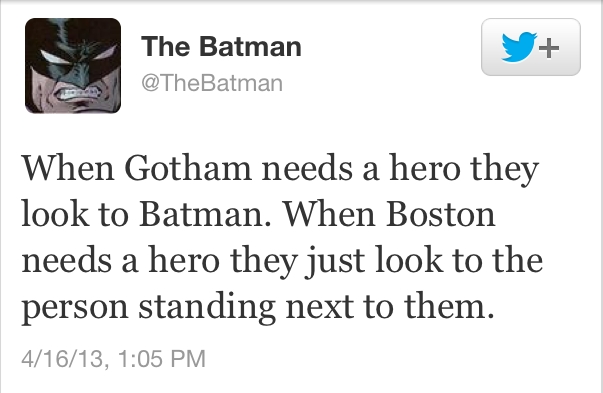
I remember David Letterman’s first broadcast after 9/11. He stood in front of the audience and said he was having a tough time getting back to work, going from such horrific events to getting back on stage trying to be funny. I am a Massachusetts resident, and while I live over 20 miles from Boston, I, as many of my suburban neighbors will refer to Boston as our home, and only when asked specifically where we live would we mention the exact town. It was a tough week, a frightening week, an event that has yet to be explained. What struck me most was the scene right after the explosions occurred. People were running. Not away from the blast, but towards where it happened, to help their fellow person. This tweet really said it best.
bostonbatman

This past week produced many victims, but also highlighted a city of heroes. Onto my weekly roundup.

The Weakonomist lamented how Cell Phones Killed The Dial Tone. One of those subtle things you don’t often consider. The dial tone takes network time. No need for it, just get the whole number queued up and send it. Dial tone is an artifact of a bygone day. Our children won’t know what a dial tone is, or for that matter what a dial is. How many dials are still in your house?

The Financial Buff, Harry Sit, wrote about Obama Budget Limits Tax Deductions On 401k, Health Insurance, and Muni Bond Interest to 28%. It will take some more time for all of this to be understood, the budget is a huge 256 pages, with a huge list of proposals likely to impact your finances. We’ll see how much of it actually passes, and as details come in, share some planning tips with you.

Jim Wang asked Your Take: Do You Owe Anything for Free Sporting Event Tickets? This took me back to Barb Friedberg’s Mental Accounting post. If someone invited me to an event, why should the source of the tickets matter to me? Of course there’s a difference between me jumping on 4 Rolling Stones tix, and then asking who’d like to join me, but pay for their ticket, and tickets that I’d gotten free. But when you’re invited to a ticketed event when you know the friend got those tix free, why wouldn’t you buy a round or two, or pay for parking?

Brock, the Clever Dude, told us about A Little Known Cut of Steak That Will Rock Your Face. This sounds like a good thing, so I’m all for it. You have to read the article to find out what cut he’s talking about, but I’m in. Next visit to Costco, I’m checking out this cut of meat. It might even warrant a frugal Friday mention if it’s that good.

Craig Ford discussed 4 Reasons to Give While Paying Off Debt. At Money Help For Christians, Craig writes on the usual financial topics, but with a focus on Christian values and charity. Craig has a special place in his heart for philanthropy and after reading his blog for some time now, I can only say the world would be a better place if more people adopted his attitude. He takes ‘generous giving’ to a new level.

We’ll close this week with a post from My Retirement Blog – Can One Retire on Social Security Alone? Andy Hough made an interesting observation, new to me; According to the Social Security Administration, benefits make up 90% or more of the income of 36% of the people receiving benefits. An interesting point to note. I always thought of Social Security as a supplement, not my primary retirement account.

That’s it for this week. Be well.

{ 2 comments }

Boston Heroes

bostonheroes

My prayers are with the victims of the recent attack in Boston.

{ 0 comments }

Frugal Friday Week 37

If you are old enough, you remember when long distance cost a small fortune. It was that way growing up in New York in the 70’s and Long Island (part of NY State, but not the city) was a long distance call, and about 15 cents a minute, if memory serves me. And somehow it was the home of my first girlfriend, whom I met at a Star Trek convention. But I digress.

The cost of telephone has dropped over time, but not quite where it should be, given the competition. This is when I admit I’ve made a mistake over the last 10 years or so, keeping Verizon for my landline phone. Now that my daughter has her own cell, and we’re all on Verizon Wireless, it seemed there should be some kind of deal for the landline, anything less than the $50 we were paying. Yes, there’s a $12 service. But it then adds nearly $11 in taxes, including a $6.39 federal access recovery charge. It seems this charge is “a way to recover a portion of the costs incurred by providing other carriers access to the network.” No, it’s a way for you to extract money from me.

I’d have quit at $23, but that service didn’t have caller ID. $10.50 extra for that. I like Caller ID. I can let the machine take it if I don’t recognize the number or if it’s my mother. I’m kidding, mom, I always grab the phone when I see it’s you. Really. So, we are pushing $34, and that’s with no long distance. On this plan, just to be able to dial long distance costs $6 per month minimum. There’s no option to just pay whatever rate per minute but with no monthly minimum. I hadn’t yet checked to see what it would cost to add phone to my Comcast TV/Internet plan, so I went online to check. While on the page of services to add, a popup screen came up, offering a chat.

comcastsuport

When it first came up, I thought that the use of ‘live’ was redundant, but then I recalled that Verizon’s site actually had an automated system. A system that couldn’t any any questions at all, by the way. So you can see, I was eager to ask the live specialist the simplest question he’d ever get, “What would it cost to add phone 9to my account)?” Whoa! That’s beyond a specialist, I needed someone on the customer service team.  I looked at this answer for a moment, and figuring ‘in for a penny,’ I asked, “What kind of question would you actually be able to answer, if not this?”  He politely disconnected.

The customer service team member I called told me $14. I asked how much for the crazy taxes. He said the real price was just over $12, and the $14 included tax. He also warned me that there was a $50 fee from somewhere to transfer my phone number. So I break even in 2-1/2 months, and save $20/mo after that. And I get unlimited long distance for free. By coincidence, Verizon happened to call me later that day, telling me they wanted to visit to switch my phone from the copper wire to fiber. I told him I wasn’t home, and would have to get back to him. Comcast is visiting next week to switch my phone over to their service. If Verizon wanted, they could offer a deal for their multi-cell-phoned customers, but it seems they keep both sides of the business separate.

Do you still have a landline or have you cut the cord completely? What’s that landline costing you, if you still have it?

{ 3 comments }

Stock Diversification and Coin Flips

I wrote about this five years ago, in my pre-blog days, time to revisit and share with new readers.

Today, we’re going to look at a complex topic, how diversification helps reduce your risk when investing in stocks. I’m going to use an analogy, coin flipping, to simulate stock returns in a way that should help simplify the concept. We’re going to start with a simple idea, a game in which you flip a dollar coin and if you bet right, you gain 30 cents, if wrong, you lose 10 cents. It’s an exaggerated way to simulate the stock market, either +30% or -10% on a dollar bet.

flip1

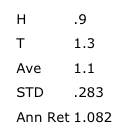
The above summarizes the results for one flip. For sake of easy math, -10% is listed as .9, and +30% is 1.3. The average is 1.1, a 10% return, not too far from reality, and a simple standard deviation calculation shows .283 quite a bit higher than the S&P standard deviation. For annualized return I take the geometric mean, the square root of .9 *1.3. Bear with me. It gets better. The next step is to split the bet. After all, the odds are in your favor, right?

flip2

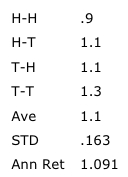
You can see that a loss requires two heads, a one in four event. Half the time you will get the average 10% return, and a one in four chance at 30%. The important thing to note is that while the average didn’t rise, the standard deviation dropped quite a bit. And the geometric mean of the 4 results gives us an annual return of 9.1%. We can continue this process following the pattern of Pascal’s Triangle

pascal

The third row here helps us understand the three coin scenario, of 8 possible outcomes, one is all heads, three is two heads one tail, etc, a pretty cools chart to understand the odds involved.

flip3

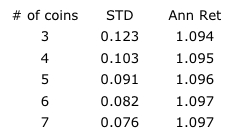
The math gets a bit more complex with each added coin, but it’s easy to see that the more flips the bets are spread across, the lower the standard deviation, in other words the results cluster more closely to the average, and the geometric mean also improves in the process. That’s my thought for today, the math of stock diversification is similar, yet far more complex to explain as each stock has its own set of risks. I hope this made the process a bit easier to understand.

{ 5 comments }

Average Return vs Compound Annual Growth

Every so often, it’s time to look at the terms that we use when discussing financial matters. I’d like to take a look at the terms ‘Average Return’ vs ‘Compound Annual Growth.’ These two phrases sound similar, yet the results can be quite different.

The math isn’t complex, so we’ll start with a simple example. Two years, the first year is up 20%, the second, down 20%. It’s pretty obvious that the average of +20 and -20 is zero, no surprise there. But the compound annual return is a bit different, as 1.2 * .8 = .96 and this results in -4% over a 2 year period or a true return of -2%/yr CAGR. I know that too many numbers make your eyes glaze over, so an image:

CAGR

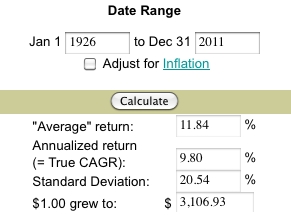
This comes from the site Money Chimp, where you can check the market return between the end of two years, and adjust for inflation if you wish. It’s one thing to see random numbers trying to illustrate a point, and quite another to see how it would actually impact your money using real data. You can see that the Compound Annual Growth of “True CAGR” as the Chimp calls it, lags the Average by a full 2%. This is a result of the volatility of returns, as in my exaggerated example, a -20 cannot simply be averaged with a +20.

I don’t know what the market will do in the future. No one can know, really. But I do know how to look at the past, and to look at this specific period, 1926-2011, and suggest it returned 12% is simply incorrect. Had we actually seen 85 years of 11.84%, the result would have been a $13,513 return, four times the final return. Lest you think that the difference of 2% was a result of the 85 year time horizon shown, head over to the site and just enter 2001 and 2010 as the beginning and final years. You’ll learn the disparity is formed by both volatility as well as time, so even short periods are affected.

I was recently reminded of Dave Ramsey’s 12% ongoing market claim, and re-read his article The 12% Reality. In his article Dave confuses simple with compound average and stands his ground. He even discusses the so called Lost Decade; From 2000–2009, the market endured a major terrorist attack and a recession. S&P 500 reflected those tough times with an average annual return of 1%. Last I checked, ten years of 1% returns would grow your money at least 10%, no? The calculator shows us a True CAGR of -.99% for a cumulative loss of 9% over the decade. Let me spell that out – You started the decade with $10,000, and ended with $9,100, a bit less after expenses. Dave’s claim that you’d have $11,000 or so misses the true number by 20% for the decade.

I’ve always loved math, and find that it’s tough to argue with facts. Next time someone starts quoting market returns, remember, knowledge is power, and you’re now armed with the knowledge to help you understand the numbers and educate others.

{ 10 comments }