≡ Menu

A Spring 2013 Roundup

We start this week with Young Cheap Living’s Open a Roth IRA and Buy a House? Um, No Thanks. It seems that Kraig doesn’t care to tie his money up long term, not in a house nor in retirement accounts. I never minded the tied up factor, but agree it can be a bit off-putting to some investors.

At Afford Anything, Paula Pant discussed whether to Pay Down Your Mortgage or Invest the Cash? It’s not a simple decision, in fact, there’s no ‘right’ answer, only what’s right for you.

The Amateur Asset Allocator asked Dave Ramsey Investment Advice: Is It Really THAT Bad? Kyle’s concerns included David’s suggestion that investors can expect 12% annual returns, and plan for 8% per year withdrawals at retirement. I’m in agreement, neither of these expectations are sound advice.

The Investor tells readers Why you probably shouldn’t be picking stocks (again). A great read on why individual stock picking is a losing battle, and the average investor lags the market by a huge margin.

We’ll end this week with Donna Freedman’s In which I cop to some odd habits. Sorry, Donna, you are 100% normal, an interesting look at what you may think odd, but a list of quirks that most of us probably can relate to.

Spring is here, but we still have 6 foot piles of snow out back, global warming, I know.

{ 0 comments }

Kill Phil?

killphil

It seems that Punxsutawney Phil has made a mistake. He forecast the end of winter, yet here we are in the northeast with piles of snow still here after spring has appeared on our calendars. This might still not be newsworthy, but it seems an Ohio prosecutor is now demanding (a bit tongue in cheek of course) that Phil be put to death over this recent faux pas. Me, I’m just waiting to see if there’s any grass left once my snow melts.

{ 0 comments }

Wiping out Poverty?

I saw a tweet that read “knowing that world’s top 10 richest could wipe out poverty and not even notice the money’s gone sickens me.”

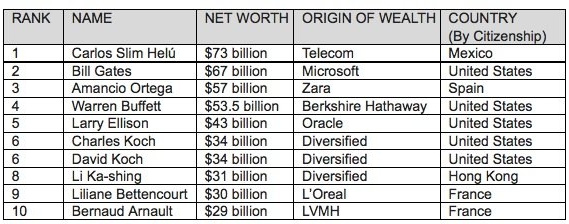
A very interesting idea, but is it true, and if not, how far off the mark is it? Business Insider recently wrote an article looking at the Forbes top 10 Billionaires –

richlist

Add them up and we have $451.5B. Nothing to sneeze at, but how much good would this money do? The site Global Rich List tells us that half the world’s people live on less than $850 per year. If we confiscate the entire wealth of these top ten, we can give each of the 3 billion people at the bottom $150 each. That won’t quite eliminate poverty, not by a longshot.

To be fair to the gal that tweeted this, the distribution of wealth in the US is highly concentrated. Data shows the top 1% own approximately 40% of all wealth in this country. That’s about $24 trillion. Divide this over 3 billion people and we have $8,000 per person. Now, that might be enough to change the lives of the world’s very poor, although it’s not likely to happen anytime soon.

I’m sorry to say this is a problem for which I have no answers, not today.

{ 2 comments }

A guest post from Joshua Rodriguez –
These days, the average American is no stranger to credit card debt. In fact, we love using our credit cards. But, after war and world-wide financial recession, many of us are starting to re-think our decision to use our cards so frequently. The truth is, more and more consumers these days are becoming interested in paying off their credit card debts. Although, at first glance, this task can seem a bit overwhelming, the truth is, it’s not that difficult. All it takes is a plan and you committing to it! Come on, I’ll walk you through it…

A Step By Step Guide To Getting Rid Of Your Credit Card Debts

Step #1: Preparing For The Battle – I’ve never heard of a fighter winning the belt without preparing first. The truth is, not using your credit cards is going to be a battle best fought with the right weapon. In this case, that weapon is your credit card profile. All this is is a list of your debts. In your list, you should include lender names, balances, interest rates, minimum payments, customer service phone numbers and pay-to addresses for each of your credit cards with a balance.

Step #2: Taking Advantage Of Your Qualifications – The lending industry is a very competitive one and, if you are a customer that is known for paying on time, they will compete for your business. One way that lenders do this is through balance transfer credit cards. If so, check out the market to see if there are any offers that provide lower interest rates than the rates you are currently paying. If so, apply and transfer your balances to lower long term rates!

cut-up-credit-card

Step #3: Commit To A Constant Payment – Your credit card minimum payments are based on your balances. When paying off your debts, this is a crucial factor. If your payments go down every time your balance does, you will NEVER pay off your credit cards! Your best option is to come use an aggressive plan of attack known as the constant payment plan. To do so, add up all of your minimum payments. Now ask yourself, “Is this all I can afford to send? Can I comfortably send extra?”. No matter what you decide, write down the total amount of money you can comfortably afford to pay towards your credit card debt. Now, you have to commit to sending no less than this month’s payments until your debts are completely paid off. If you do, you stand to save hundreds or even thousands of dollars in interest charges over the life of your debt. Which, will now be years less!

Step #4: Go After Your Highest Interest Rate First – Now that you have decided on a constant payment, it’s time to make sure that you get the most out of that payment. To do so, we need to attack the highest interest rate first with the debt stacking plan. Stacking your debts is a very easy thing to do. After all minimum payments are made each month, send an extra payment to the highest interest rate account with the remaining funds in your constant payment. By sending all extra funds to your highest interest rate debt, you will quickly pay it off. Once this happens, send all extra funds to your next highest interest rate. Continue to do this until all of your credit card debts are completely paid off!

The End Result

As a personal credit card debt consultant, I have seen this plan save quite a few people thousands of dollars and years in time paying off their debts! By following this plan, you will reduce your interest rates to the lowest rates you qualify for and attack your highest interest rates with aggressive payment plans! All it takes is a bit of commitment on your end and you will be debt free in no time!

About The Author – Joshua Rodriguez – This article was written by Joshua Rodriguez, proud owner and founder of CNA Finance. Join the discussion about this article on Google+!

{ 2 comments }

A 2013 St Patrick’s Day Roundup

Let’s start this week with Donna Freedman’s Does frugality have to hurt? Is it “no pain, no gain” or is there more to frugality than depriving yourself?

At Free From Broke, Miranda wrote a comprehensive What Are Required Minimum Distributions (RMDs) and How Do They Affect Your Retirement?

Next, we have a money saving tip from Mr Money Mustache -A Side Dish of Free Data for your Cheap iPhone Plan. If you’re a low usage customer, a few hundred minutes, and little data needs, this tip can save you up to $50 compared to your current phone plan.

3 Reasons Saving For Retirement Should Be Legally Mandatory – The Amateur Asset Allocator think we are a nation that’s not saving enough, and I agree whole heartedly. Kyle offers us three reason to force our saving rate to a reasonable level.

At Budgets are Sexy, my friend J Money wrote How Rich People Think (vs Middle class.) One great example – “Middle class sees money through the eyes of emotion. The wealthy see money through the eyes of logic.”  This line reminded me of a recent dialogue I had with a fellow blogger and will set the stage for a post of its own, soon.

And we’ll rap it up this week with The Investor’s Know your own risk tolerance, post at Monevator.  A fascinating discussion of risk, with examples of risk aversion.

{ 1 comment }