≡ Menu

Sweet Freedom

sweetfreedom

A state judge has struck down NY Mayor Bloomberg’s rule regarding the limit of soda size sold at various locations in the city. In response, Mississippi has their own anti-Bloomberg bill, limiting the ability to even require restaurants to show calorie counts on their menus.

We tax alcohol and tobacco. Is it time for a special sugar or corn syrup tax?

{ 0 comments }

Mom – You don’t itemize!

Note – this ‘letter’ is to my mother-in-law, whom I sometimes just call ‘mom,’ even though she’s fine with my using her first name. She’s a widow, and in her 80’s.

Dear Mom,
It’s no burden for me to do your taxes, in fact, I enjoy the process. After you and dad (who passed away almost 8 years ago) told me what you were paying for your tax guy, I thought I could save you that money to spend on something else. The fact that the tax guy wasn’t really a financial planner also gave me the opportunity to offer some advice that would help save on your tax bill each year.

I just looked at the folder of paper to start doing this year’s return. Wow. A lot more than we really need. Here’s why – you don’t itemize. To take any deduction for medical expenses, you need to be out of pocket more than 7.5% of your adjusted gross income. Even though your bills feel like they were in the thousands, the amount you had for copayments didn’t even add up to $1000. Your standard deduction is $7400. Your Condo property tax and interest (you own your unit, but there’s a master mortgage on the property) along with your donations aren’t anywhere near this. A few years ago, when you had one really large donation we used a Qualified Charitable Distribution from your IRA. Since you were going to make that donation anyway, by using money from your Required Minimum Distribution (RMD), it made that distribution tax free. I thought that was pretty cool, but this year it was pages of small donations, so we agreed to pass on the QCD trick.

All in all, there are a handful of numbers to enter. Your pension, dad’s pension you still receive, social security, and the transactions from your brokerage accounts. What makes it even easier is that TurboTax (disclaimer, right here, for FTC, this is an unpaid mention) will pull the yearend data from your Schwab (FTC – ditto) account, so I don’t even type those numbers in.

The other thing I do for you is to convert a bit of you IRA each year to your Roth account. This way you pay 15% on the money, and it keeps growing tax free. If we didn’t do this, your RMDs would keep increasing each year and you might be pushed into the 25% bracket. You’re not even spending your RMD, and the girls and I keep telling you that you should spend more on yourself. But, if you need to withdraw more than your RMD and should start to hit the 25% bracket, you can use the Roth money. If I did two thing right for you, it was this – a balance of stocks and CDs so you were buying in at the bottom, and rebalancing at the tops. You have more now than you did 10 years ago, even after withdrawals. And keeping your tax rate right at 15%. This is one strategy that’s perfect for someone in your situation, just enough income to let you convert a bit each year to top off that bracket.

I hope you understand a bit better why I don’t need all that other stuff every year, but I’m pretty sure it will all be there next year when I look at your 2013 return. And I’ll explain again, ‘you don’t itemize!’

{ 2 comments }

The 15% solution

I recently read a question from a fellow blogger Briana, who posts at How’s Married Life asking how much she should save to her retirement account each year. As I saw comments come in, for me the larger question wasn’t how much, but simply ‘how.’ Should she save pretax, or post? In the big picture, this question might take second place to the first, after all, the question of how much is such a large factor toward retirement success.

Let’s look at my concern, how she should handle the tax status issue. In her question, she shared her gross salary is $33K.  In 2013, the 15% bracket runs from a taxable $8,925 to $36,250. With no mortgage (yet), I’ll trust she’s taking the standard deduction  of $6100 along with an exemption of $3900. Pretty neat, this adds to exactly $10000 that comes off the top. At this stage of her life, I’m expecting good things in her future, and that includes a higher income.

I suggest that she start now with the Roth 401(k) and Roth IRA for the money she’d like to save. The Roth 401(k) to get the full match her company offers, and the Roth IRA for any more deposits above that. It will take some time before she’s starting to hit the 25% bracket. After all, she would need an income above $46,250 for that to occur when the standard deduction and exemption are included.

As time passes, and she sees her income rise, I suggest monitoring that line on her 1040, “taxable income,” this is the line that tells you what bracket you’re in, and as she slips into the 25% bracket, it’s time to take advantage of the pre-tax retirement accounts as well. Say, she’s finishing her return one March and sees the taxable income is $1000 into the 25% bracket. That’s the time to deposit exactly $1000 into the pre-tax IRA, and start using the pre-tax traditional 401(k) as well just for a portion of her deposits. Say she’s decided to target 10% of her income towards the retirement accounts. It will take $51,389 gross income and a pretax deposit of $5,139 to net that $46,250 I mention was the gross cutoff for the 25% bracket. Keep in mind, that’s in today’s dollars, with today’s tax brackets and current standard deduction/exemptions. These numbers are all inflation adjusted each year and this combination will help shift that target 15% limit as Briana’s income rises. It may take as long as a decade or more for this to occur, which is fine. Ten years of saving post tax money in these accounts before making the shift to pretax savings means her tax burden after retirement will be that much lighter.

The story doesn’t end here. If, and when, she has a new addition to the family, there are more tax deductions that come with the new bundle of joy. Briana may have spent a bit of time fighting off a 25% tax rate only to take a bit of time for maternity leave and drop back to 15% again that year. The good news is that with a bit of planning each year for the year to come you may find the 15% solution works to keep your taxes low while your working and then at retirement when you find your funds have a decent share as post tax Roth flavored money.

On a final note, recent changes in the tax code permit a conversion of 401(k) funds from the pre-tax account to the Roth 401(k). Since matched deposits always are deposited to the pretax traditional side, you’ll still accumulate pretax money over time. If you have extra money you’d invest for the long term and the 401(k) fees are reasonable, it may make sense to do the conversion if you will still be in the 15% bracket. There’s no recharacterization option, so plan wisely.

Briana, I wish you health, happiness,  and wealth. Best of these to you!

{ 5 comments }

A Post Operative Roundup

We’ll start this week with Pragmatic Capitalism’s It’s 2000 & 2007 All Over Again. Has the market come too far too fast? We are just above 1500 on the S&P after 13 years since it was 1500 the first time. Is it time to worry another decline is coming?

Investors’ Quandary: Get In Now? – The Reformed Broker, Joshua Brown tells us why this is the Wrong question. I’ll spoil the punchline, the correct question is “Why are you out in the first place?” I agree, there’s a never ending cycle of buying just as new highs are reached, so the same people that panic-sold when he S&P dropped below 800 are now thinking 1500 is time to buy back in. I’m in it for the long term, but if I were thinking of reducing our stock allocation it would be just as this money flows in.

At Couple Money, Financial Samurai suggests ways to Beef Up Your Job Loss Emergency Plan. Sam explains why getting laid off from work might not be a bad thing, and I’m convinced he’s right about that. If you’re getting burnt out at your current job, a layoff may be a blessing.

This week there was a lively discussion at Man vs Debt. Joan Otto, Man Vs. Debt community manager, wrote Are 401(k) and 529 Plans a Good Idea When You’re In Debt? In this article, Joan makes the case for skipping the 401(k) for the time it takes to pay off your debt first. I offered the comment that someone should never walk away from the free money of a matched deposit. Joan kindly stood her ground preferring the motivation of seeing the debt reduced as fast as possible. Let me just say this -  I know it’s not always about the numbers. There’s psychology, feelings, and sleeping at night. Know what? That’s ok, too. One size doesn’t fit all, and if the math doesn’t impress Joan, I’m not insulted.

Barbara Friedberg talked about The Overlooked Wealth Building Trait. You don’t know what it is? You will.

My friend John Wedding will tell you why A pizza guy shouldn’t make a cardiologist salary. Seems a delivery guy received a $10 tip on 85 pizzas costing over $1400. What do you think? $10 was too little? (Agreed) But how much is too much? $210? And what’s ‘just right’?

This week I had two guest posts I’m proud to share – At Block Talk, H&R Block’s Tax Blog – my Top Ten Tax Audit Triggers. For the tax pros in my audience, let me know if you think I missed any. And at TurboTax – Save More Green with Daylight Savings and Energy Efficiency Credits.

And that’s a wrap for the week. Uh, not yet. Post Operative? Oh, right. Jane had a bit of pain in her stomach this past week, and went to see a doctor on Wednesday. 1PM Doctor Visit, 4PM MRI. And off to a 9PM surgery to remove her appendix. That made for a bit of a stressful week in the Taxpayer household.

{ 1 comment }

401(k)s of the poor and homeless?

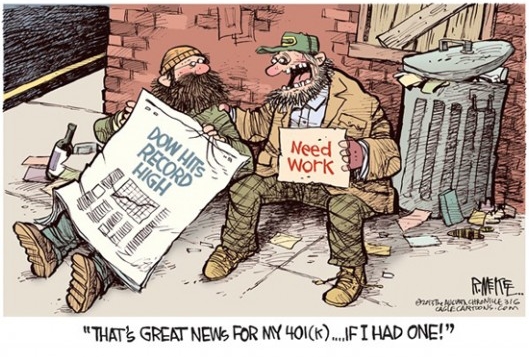
the-destituteAs we watch the financial news and celebrate the market’s new highs*, let’s not forget those for whom these numbers really have no meaning. The poor and not so poor who simply haven’t saved. Nearly half of us have little to no savings at all.

* I know, the S&P 1500 of today isn’t the S&P 1500 of the year 2000, there’s some adjustment for the dividends along the way as well as inflation. One more reason the indexes are meaningless, it’s each year’s return that matters.

{ 0 comments }