≡ Menu

Learn How to File a Credit Dispute

 A Guest Post from my friends at Consumer Law QA

If you have ever been asked to pay for a credit report, then you probably didn’t realize that the Fair Credit Reporting Act (FCRA) demands that all of the 3 nationwide consumer reporting companies, which are Experian, Equifax and Trans Union, are obliged to provide you with a copy of your credit report free of charge. You can request your free credit report at Annualcreditreport.com.

This report is only issued if you request it and it should be provided once in a 12-month period. If you require further credit reports within the same 12-month period then you will be asked to pay. The FCRA prioritizes the privacy and accuracy of any information held by the consumer reporting companies. The Federal Trade Commission (FTC) has the job of enforcing the FCRA requirements. If you have a credit dispute leveled at one of these companies, then you should compile a credit dispute letter, which is your legal right. You may download a credit dispute letter sample here.

A credit report should include personal information about yourself, such as your place of residence, the method you use to pay your bills, if you have ever been sued and if you have ever filed for bankruptcy. Your credit worthiness is also included in the report, through providing information about how much available credit you have and your present debt situation. The approved reporting companies are allowed to sell the information provided in your report to insurers, creditors, employers, and any other businesses that may use it to assess any applications you have made for credit, employment, or, for example, renting a house.

It is vital to you that all information is correct, particularly if a potential employer, an insurance provider or the owner of a property you wish to rent requests the information. If some information is incorrect then you are entitled to lodge a credit report dispute to the reporting company concerned by using a credit dispute letter. Sometimes, there are old debts remaining on your credit report.

Usually, there is no need to do anything to erase repaid debts from your credit report, as these should be deleted automatically from the credit report. However, if outdated accounts still remain, you can make use of the credit report dispute process to ensure they are removed.

In the credit dispute letter you should write down what information you have found to be inaccurate in the report and why it is not accurate. You should then ask the credit reporting agencies to investigate the matter and delete or amend the disputed information as soon as possible. If you have any documents to prove your situation, then you should make copies and include them with the letter. A list of these should be written at the bottom of the letter, so the person who opens it will be able to account for the enclosures. Never send originals, as it is far too stressful worrying if they will ever be returned.

You can also include a copy of the credit report, ticking or circling the items that have been reported incorrectly. Don’t forget to send the letter by using certified mail. Also, ask for a return receipt, so that you will know that the reporting company actually received your letter and any additional enclosures. Before mailing the credit dispute letter, make sure you have made a photocopy, so that you have a complete record of the correspondence at hand, if required.

If the furnisher (debt collector or creditor) of the information does not respond to the investigation, the item must be deleted.  But the time frame is not necessarily 30 days because the CRA may request an additional 15-days if it receives information from the consumer relevant to the investigation.

If the furnisher does not respond, the CRA must treat the information as “unverifiable,” which means that it must promptly delete the information and notify the furnisher of the deletion.  If the furnisher wants to reinsert that information, the furnisher must certify that the information is complete and accurate.  Then the CRA must notify the consumer in writing within five business days after the reinsertion. If you find it difficult to file a credit dispute on your own you should contact a consumer law lawyer to help you with it.

 

{ 2 comments }

A Collapsing Economy Roundup

We’re going to start this week’s roundup on a bit of a serious note with Economic Collapse 101: What It Will Look Like, and How It May Start. My friend Len Penzo thinks we are in for some tough times ahead, focussing on the national debt that appears to be rising with no end in sight. I can’t say I disagree with Len’s warning, but for all our sake, I hope he’s wrong.

At Green Panda Treehouse, How Do You Deal With Financial Peer Pressure? An excellent question, as pressure comes from all directions, friends, family, neighbours, and nearly everyone we encounter. Here’s some great advice on how to handle it all.

An interesting article, The Challenge of Defining Wealth was posted this week at Five Cent Nickel. Is it income? Retirement savings? Credit? How do you define wealth?

If Len’s ominous warning weren’t enough to ruin your day, Money Reasons tells us Why Unemployment Is Likely To Be Higher Than In The Past 50 years. It’s not a cycle, it’s a shift in the world’s labor force.

One Frugal Girl tells us why she Unsubscribed: So Long Bargain Blogs. I understand where she’s coming from, a bargain is no bargain if the item you buy wasn’t something you’d have bought anyway.
Does a Stock Split Matter? is asked (and answered) at Money Mamba. While a split doesn’t change the actual value of a company, it does make it more accessible for the average investor. Think about it, would you buy one share of a $10,000 stock as quickly as you’d buy 100 shares of a $100 stock?

{ 0 comments }

Horse Sense?

horsesense

It seems that horsemeat has made it into the food supply of some restaurants in Europe. US Government officials have assured us that the US meat supply remains unaffected. Strange turn of events.

{ 1 comment }

Time to Raise The Minimum Wage?

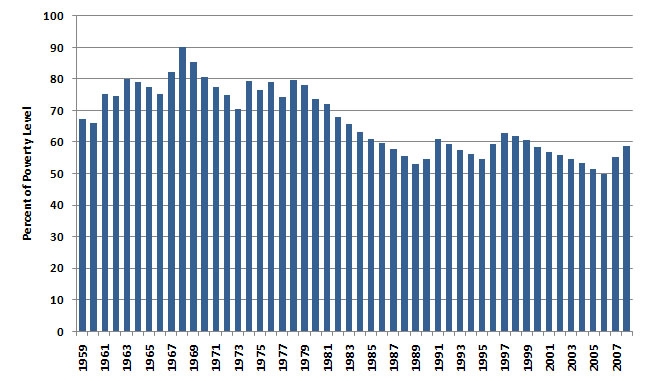
President Obama recently called for an increase in the minimum wage, from the current $7.25 to $9.00 per hour. I found two charts to be of interest in furthering this discussion. First, the minimum wage as a percent of poverty level income.

poverty

This graph helps illustrate how those earning only minimum wage have failed to keep up with inflation and from a high of 90% of poverty level income are now closer to 60%. I’m not suggesting the minimum wage should be a particular fraction of poverty level income, just observing this graph goes in the wrong direction.

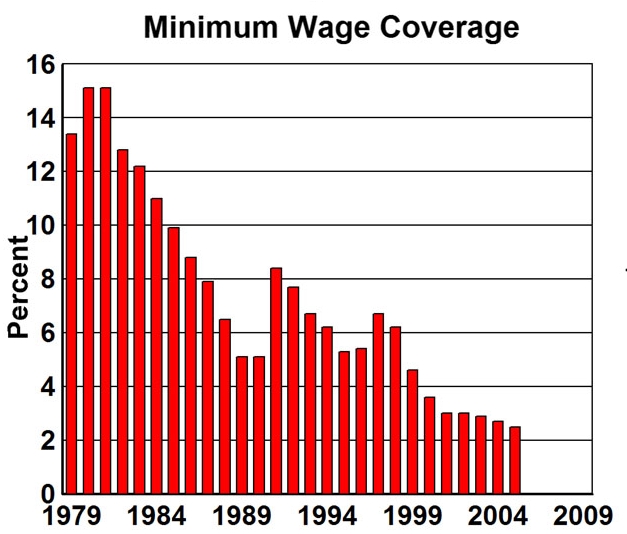
I know that there’s a strong case to be made for higher minimum wages resulting in the loss of jobs, although the data supporting this is a bit sketchy. I’d like to offer one more graph to show why I feel this way.

minwagecoverage

We are talking about just 2% of workers. Had the minimum wage tracked inflation, adjusted annually, businesses would have planned for it and dealt with the cost each year the same as they deal with rising fuel bills or any other component of their costs. With half of these workers being under 24, and not necessarily family breadwinners, we shouldn’t forget the half who are.

I remember a $3.10 minimum wage. It was enough to have pocket money as a teen. And it was awkward working side by side with those who were lifers, people who did this not for beer money, but to pay their bills. Keep in mind, if you look at $3.10 in 1980, it inflation-adjusts to $8.50 in 2012.

{ 2 comments }

5 Essential Steps to Prepare for Tax Season

Take simple steps to reduce your stress on the big day.

Meeting with professionals or doing taxes yourself can prove stressful, as it’s often required to have numerous documents, legal forms, bank account information, tax IDs, and more, all at your fingertips. Here are some tips from professionals that can help you make this tax season a little less stressful.

1. Get organized

Even though we are well into the new year, it’s never too late (or early) to start organizing and collecting forms and documents you’ll need to do your taxes. If you haven’t received a W2 or W9 from last year’s employers, give them a call or send an email requesting a digital copy and a printed copy mailed to your residence. Having the digital copy stored on your computer in an appropriately labeled folder can help you keep documents organized and easily available should you lose the physical copy. In addition to requesting digital copies of forms scan in or take photos with your cell phone of the various physical tax-related forms you’ll be receiving, you’ll thank yourself later.

2. Ask the right questions

As you request and organize your tax forms, be thinking of questions you have about filing taxes for this year. Have you invested more than usual, taken money out of stocks, bonds, or an IRA? Have you spent more than usual on education, your mortgage, a car, or received a large sum of money from a deceased relative? Write down any questions or note-worthy events that happened during the year, and any numbers related to those things for reference when filing your taxes. If you meet with a tax professional, be sure to raise your questions when you begin, and if you’re filing yourself with software, make sure during the process your questions were addressed (if not, email customer support for clarification).

3. Search for deductions

Before you meet with your tax professional or start filing on your own, start looking up deductions related to the questions you’ve written down. Think of anything you spent money on this year that was outside the norm, and search for tax deductions related to your expenses. You may be eligible for reimbursement for home improvement items like roofing, air conditioner repair, or energy efficiency upgrades. Tax incentives for fuel efficient cars, education, starting a business, or donating to a church or other charity are also commonly overlooked by people filing their taxes.

4. Use legitimate software

If you’re going the do-it-yourself route of filing taxes, make sure you use some legitimate software that’s been well reviewed. Especially during this time of year, internet advertisements explode across the web directing users to use foreign, questionable, or insecure tax filing solutions. Most legitimate companies that offer software for filing from home will offer email, phone, and web support to help ensure you have the help you need to get your questions answered. Make sure you look at the beginning of the web address you’re using for “https://” instead of just “http://”which signifies a secure and encrypted connected with the remote server.

5. Plan to e-file

Filing your federal taxes is free and easy when you use the government’s e-file system. Most software based tax companies offer to file your federal taxes for free, as it’s so easy to do already. The main benefit to e-filing your taxes with the federal government is that your return is almost guaranteed to come weeks if not months earlier than if you opt for the mailing method.

Aimee Watts is a staff writer for Mobile Moo. She has spent ten years telecommuting full-time, and loves spreading tips and advice for fellow work-at-home parents. She loves gadgets, new ideas, and skiing with her two favorite people: her husband and teenage son. They live in Evergreen, Colorado.

{ 2 comments }