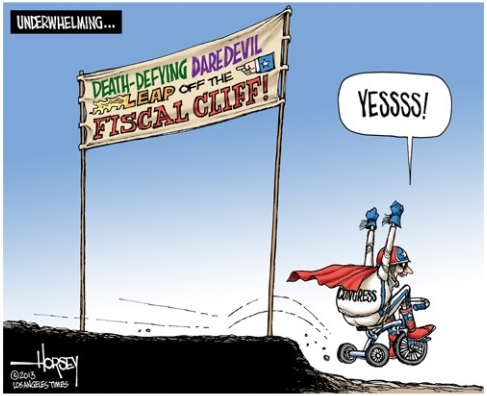
I don’t know when I first heard of this, the minting of a single trillion dollar coin to avoid the debt ceiling, but it struck me as absurd then, and I’ve not changed my mind since. No good can come from this idea. There are questions as to whether it’s even legal. To add to the absurdity, why not mint 20 of these and retire all the US’ outstanding debt? We need to get spending under control, simple as that.
Not quite, but close to it for many taxpayers.
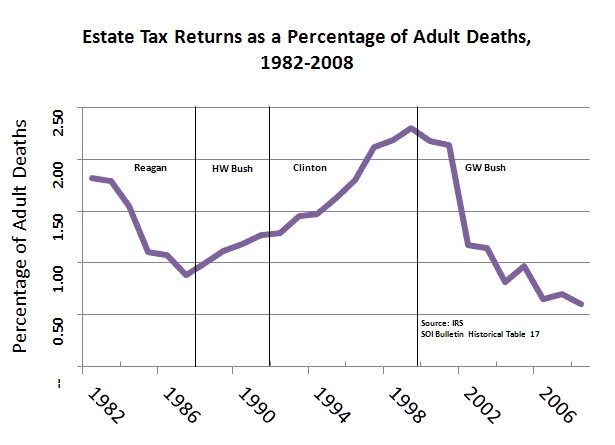
As part of the American Taxpayer Relief Act (ATRA) of 2012, a benefit you may appreciate has been slipped in, a ‘permanent’ fix to the estate tax issue. First, here ‘permanent’ simply means a provision that has no sunset date, no automatic falling off the tax forms. That said, let’s look at the estate tax, before and after, and why you should be concerned about this even if you are not a ‘one percenter.’
In 1998, the year our daughter was born, we bought life insurance. Since we both worked, and had similar incomes, we each bought a million dollar policy. This may sound like a lot of money, but we had a house with a mortgage, and college tuition 18 years hence, both of which would whittle this windfall down pretty fast. But. As I learned in 1999, estate tax would kick in for an estate over $650,000. So even if we had no other assets, our insurance of $2M would see $700K taxed as high as 50% if my wife and I should perish together. It gets worse from there. If I passed first, I could leave an unlimited inheritance to my wife, but then if she would die soon after, $1.35 (everything over $650K) is subject to estate tax. Off to see an estate attorney. Time to set up trusts. With a bit of financial smoke and mirrors, the insurance is purchased from small gifts given to my daughter through the trust. In other words, the insurance itself is not part of our estate. Back then, I’d have casual conversations on death and dying (I know, real ‘life of the party’ discussions) and I realized most people had no idea that if you own the insurance policy, it’s part of your estate when you die. So even a couple with a $500K policy each could be heading for an estate tax issue. Maybe not when the first person passes, but when the surviving spouse also passes and still owned all the assets from when they were both alive.
Enough history. ATRA (Bonus points – what does this acronym stand for?) provides some excellent estate tax details:
- A $5 million per person exemption (indexed so 2013 should be $5.25M)
- A top rate of 40% (kicking in on amounts over $1M taxable)
- ‘Permanent’ portability. i.e. the surviving spouse adds on the exemption to her own estate, so a couple truly has a $10.5M exemption
- The annual gift exclusion is $14K per person for the year, but the full estate tax exclusion may be tapped for lifetime giving as well.
If you are blessed with wealth over $10.5M, the $14K annual gift may not seem like much, but keep in mind it’s per giver/recipient combination. So, you and your spouse can give $56K per year to your child and spouse. You can also gift each of the grandchildren $28K. With a large enough family, the total can easily exceed $250K if you are looking to be that generous.
On a final note, you can see how, in 1998, with no clear understanding that the estate tax would take such a generous turn, it seemed the right thing to do a bit of extra planning. Today, we’d save the expense of a trust, and only have a will in place.

Another year has begun, and it’s time for a roundup, both to look at my fellow PF blogger’s thoughts on the the fiscal cliff that was just averted. Let’s get to it.
At Consumerism Commentary, Luke Landes (Flexo) wrote Fiscal Cliff Bill Passes: American Taxpayer Relief Act of 2012 (H.R. 8), an excellent summary and discussion of the tax bill that just passed.
At the finance buff, Harry Sit looks at the Fiscal Cliff Deal and Backdoor Roth, a nice new Roth feature I’ll discuss in depth in a future article.
Five Cent Nickel wrote Inside the Fiscal Cliff Deal, with his own highlights of the cliff deal.
But I have to say, the award for Fiscal Cliff blogging goes to my tax crush, Kay Bell, who kept us educated real time with her recent blog posts:
- Senate passes fiscal cliff deal
- A quick look at the fiscal cliff’s H.R. 8, the American Taxpayer Relief Act of 2012
- House passes tax bill to avoid fiscal cliff
- What’s your 2013 tax rate and other fiscal cliff tax bill questions
- Redefining ‘wealthy’ for tax purposes
- More 2013 fiscal cliff tax calculating
Wow, that’s a lot of Cliff reading, enough that I’ll wait until next week to offer a New Year’s thoughts round up. For now, I’ll just be grateful this crisis has been averted and think about my goals for the year to come. A Healthy Happy New Year to my readers.
First, a Happy New Year to my readers. 2012 is behind us and so is the talk of the fiscal cliff. Our elected officials knew we had a problem months ago, but like children with a book report due to their teacher, this issue was literally left for the 12th hour to solve. Perhaps even worse than 12th hour, it was resolved on New Year’s Day. Crazy.
That said, let’s take a high level look at how the deal made Tuesday night will impact you:
- The Payroll Tax (aka FICA) for the employee Social Security withholding was allowed to increase back to 6.2% from the reduced 4.2% we enjoyed these past two years. I dare say for most people, this may be the largest impact, especially those with an income level putting their federal taxes at zero. A 47.6% increase to their withholding.
- The rates you’ve come to know and love, 10,15,25,28,35% are all still in place, with a new rate for those who make over $400K (single) or $450K (married) 39.6%. This income threshold is above the original $250K Obama was requesting, and happens to be just over the income required to be a top 1%er.
- The 15% rate for dividends and long term capital gains will continue for all but earners above $200K/$250K (Single/Joint) who will have a 20% rate.
- The AMT (Alternative minimum tax) which needed to be addressed every year, will have an exemption of $50,600/$78,750 for 2012, and $51,900/$80,750 for 2013. It was agreed these numbers will be automatically adjusted each year for inflation.
- The ability to choose between a deduction for your state income tax or state sales tax has been made permanent.
- The child tax credit, scheduled to go down to $500, is now
a permanentextended for five more years at $1000. - The IRA charitable donation has been extended though the end of 2013. Too bad, they should have made it permanent.
- The estate tax (aka The Death Tax) has been extended based on the 2012 exemption of $5.12M per person with an inflation adjusted number for 2013 expected soon. Above this amount, and a rate of up to 40% will apply.
The details of H.R. 8, the American Taxpayer Relief Act (ATRA) of 2012, runs a full 157 pages. Over the next few weeks, I’ll expand a bit of some of the provisions worth understanding a bit better. For now, these are the highlights.
I’ve been on a bit of a sabbatical the past two months or so. Planning to be back in January with my regular writing schedule, but I didn’t want to miss the chance to offer a year end article with some thoughts of ways to save before 2013 arrives.
- Did you turn 70-1/2 this year or are you already over this age? If so, you are obligated to take a withdrawal from your pre-tax retirement accounts, these Required Minimum Distributions (RMDs) must be taken by 12/31, else you face a horrific 50% penalty on the amount you should have withdrawn. Ouch.
- While you’re looking at that RMD, you might realize that this number will continue to rise each year, and that effect will only be magnified if your investments grow at a nice pace. This prompt the suggestion that a Roth conversion might be a good idea for you. The amount converted now is taxed at your current rate and might help avoid pushing you into a higher bracket in the future.
- Be sure to use up your remaining FSA (Flexible Spending Account) balance. This account let you put money aside, pre-tax to use for medical expenses that aren’t already covered by your insurance. Typically, this includes copays for doctor visits and prescribed medicine. Even a decent insurance plan won’t fully cover those designer glasses, so one good way to spend that last couple hundred dollars is to get your prescription updated, and get a new or extra pair of glasses.
- With all the talk of the fiscal cliff, there are some things that we simply don’t know about the 2013 tax code. Neither our tax rates nor the capital gain rate is finalized. This makes the usual advice of ‘harvesting losses’ a bit less valid. If you have realized long term gains, the maximum rate is 15%, but that potential loss you haven’t yet taken might be used to offset regular income next year. To be clear, I’m talking about the stock you still own but are considering selling to capture the loss. The two possible things it can offset are gains (either long or short term) or ordinary income. It would be a shame to get caught up in the idea of taking the loss that you only benefit by the 15% you save on the long term gain. Still, be aware that after offsetting stock gains, the losses apply to only $3000 of ordinary income, the rest carries forward.
- Is it time to adjust your withholdings? In an upcoming guest article (I’ll edit and link to it in a couple weeks) I’ll review how withholdings work and why you don’t want to lend Uncle Sam money interest free.
- Have you made your charitable contributions yet? For those who itemize their deductions, donations to charity give you back a bit of your donation at whatever your marginal tax rate is. Think of it as a rebate for your kindness.
- Every time I look at mortgage rates, I see they are in record territory, lower than the last record low. Even if your mortgage is under 5%, take the time to compare your current rate to the rate you can get on a refinance. There are no-cost deals out there, so if you have say $100K left on a mortgage at 5%, but can get it refinanced to 4% at no cost, that’s nearly $1000 in interest saved the first year. You’ll note, I ignore term here. Just pay the exact same amount you were paying each month, and the $1000 saved will go right to principal, making your mortgage shorter, a nice present to yourself a few years down the road.
- And last – no financial new year list would be complete without the suggestion to bump your savings. Among the Changes Coming in 2013Â is the amount you can put into your 401(k) and IRA. It’s a good habit to bump your saving rate each year even if by only a percent.