≡ Menu

Reflection on the big M, 1000 Posts

In 2004, I started publishing the JoeTaxpayer website. It was before I heard anything about blogs, and was organized as a static web page which created issues of its own. I wrote a monthly article, and started to find other writers who started blogs on finance.

It was August 2007 when I dropped the static page layout and started using blogging software (WordPress) to run the site. Going from a monthly article to a site where I try to publish at least a half dozen original articles per month, along with the popular weekly roundup was a struggle. Admittedly, I get writers’ block now and then, but the economy offers so much to discuss, the topics will never run dry.

M is the Roman Numeral for 1,000 and today is my 1000th post. It’s been a remarkable time, I’ve commented on Stocks, Real Estate, different aspects of the Tax Code, Social Security, and more. I’ve launched a second site, RothMania which is a niche site focusing on the single topic of retirement accounts and the Roth IRA and 401(k). I’ve made many friends, both regular readers as well as fellow finance bloggers. Last October, I had the privilege to meet over a hundred of those bloggers at the first Financial Blogger Conference held in Chicago. This year’s conference is in Denver, and it’s on track to sell out with 250 attendees. In September, 2008 Tracy Coenen, a fraud examiner with nearly two decades of experience in accounting and investigations, invited me to write my first ever guest post for her site Fraud Files, an article titled, The UFF Money Merge Account Money Shuffle Explained, On my blog I went on to write a total of 35 articles proving that this mortgage acceleration product was a scam, plain and simple.

In early January, 2010, I met a woman on line (through Twitter, actually) who was responsible for TurboTax’ blog section of their website. I was honored to be invited to guest post, still under the pen name JoeTaxpayer. The people there are a good bunch, and it’s no coincidence that I’ve used their software since filing my first tax return for 1985.

I look forward to the next 1000, and to meeting more nice folk along the way toward that goal. Thank you for being part of my journey so far.

{ 0 comments }

A Summer Wind-down Roundup

The summer is quickly drawing to a close. Here most grade schools and high schools start on August 28th, the week before labor day, so just about two weeks left to go.

This week my belief regarding the 4% withdrawal rate was put in jeopardy by Rob Bennett’s Retirement Warning: The Safe Withdrawal Rate is NOT a Fixed Number. As Rob points out, the starting point for those withdrawals makes quite a difference. You might imagine, if you started in the early 80’s when the market was about to return 18% per year on average for the next 20 years you’d have quite a different experience than if you started in 2000, when the subsequent 10 years were negative. Rob explains how you might get a better feel what the market is likely to return over the next decades.

At Financial Highway, Miranda asked Focus on the Latte Factor? Or Sweat the Big Stuff? Spending is a trade-off. I’ve told my own child,”We can afford anything, we just can’t afford everything.” It’s more a matter of picking and choosing what brings you the most happiness for a given dollar.

On the subject of savings, a nice article at Mamiverse, 10 Ways to Save $2K a Year on Groceries. When the budget is just tight enough that there’s little or no money at the end of the month, it’s great to find just a few ways to save a bit, to pull you from the red into the black. This article aims to help you do just that.

Stocks should return 7.5% annually over next decade, Bogle’s new book says.  John Bogle is better known as the founder of the Vanguard Group, and commonly referred to as the father of the index fund.  His creation of the Vanguard S&P 500 index fund revolutionized an industry and help make investing less expensive for the small investor. I had my eye on an 8% return over the nest decade, but who am I to quibble with a legend. 7.5% it is.

We’ll wrap this up up with Retire by 40 discussing How early retirement will impact my Social Security Benefit. The rules regarding one’s social security benefit are not so well understood. This article will give you a great start to understanding this calculation, and what you can expect when you decide to retire and starting collecting Social Security.

{ 0 comments }

Marvin Hamlish, Rest in Peace

Marvin Hamlish passed away this week, at an all too young 68 years of age. He was composer and conductor who left us with a remarkable body of work including “The Entertainer,” otherwise known as the theme song for the movie “The Sting.”  He was one of only 11 people to win all four U.S. performing awards, The Emmy,Grammy,Oscar, and Tony. For anyone who was a theatre buff, his presence will be missed.

{ 1 comment }

Cash Hoarders – QE3 won’t help

If you have a child in your family, you’re probably familiar with the work of Laura Numeroff. She authored the books If You Give a Mouse a Cookie, If You Give a Moose a Muffin, and If You Give a Pig a Pancake. The premiss in this series is simple, one thing leads to another in a fashion that brings us right back to the beginning.

I couldn’t help but think how the same thing applies in the economy. There’s a cycle of companies hiring, people feeling secure in their jobs, spending on new homes, bigger homes, and other goods which drives up demand in all sectors and keeps those companies profitable. Of course, you might say there’s a bit of chicken and egg going on, the companies aren’t hiring because demand isn’t there.

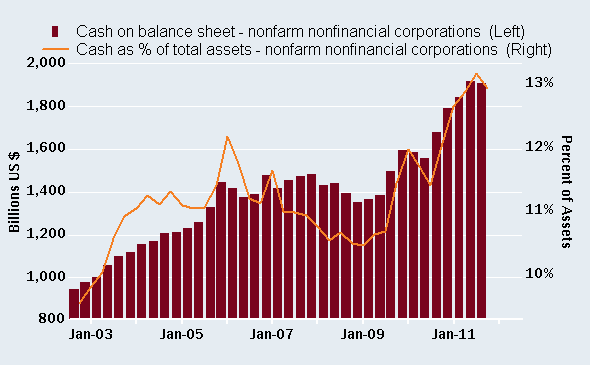
We are now looking at companies having a cash hoard of over $2 Trillion. There are times that interest rates are too high and the cost of money keeps investment down. That’s when the Fed (The Federal Reserve Bank, the Central Bank of the US) typically lowers rates in order to encourage businesses to expand. We are at a very strange juncture in this economic cycle. Mortgage rates are at an all time low but housing is still stagnant. The current 3.75% 30 year fixed rate means that a $1000 per month mortgage payment can cover a mortgage of just under $216,000. That $1000 is below the amount a median income family can budget to the mortgage, while the $216,000 is well above the median home price in much of the country. Why is no one buying? Uncertainty. People are not secure in their jobs, and are afraid to spend. Businesses are waiting to see the results of the election and understand the costs they’ll have over the next year for health care, taxes, etc.

Former Federal Reserve Chairman Alan Greenspan was interviewed last month by CNBC’s Larry Kudlow regarding this issue with the economy and he offered, “The best way I would describe it is to think in terms of two separate economies,” he said. “One is probably 90, 92 percent of the GDP and is doing actually reasonably well. The other 8 percent is largely structures or more exactly, long-lived assets. The attitude of business and households against committing to long-lived assets is extraordinarily suppressed.” This is a great observation, much of the behavior of both the consumer and corporations seems to be similar in this regard, little in the way of long term spending. It’s as though capital itself is on strike.

This brings me right back to today’s title, the fact that Quantitative easing won’t help. That’s not where the problem is. I have banks willing to lend me money short term at 2.5% (my HELOC) and even 1% for just a year (a credit card’s cash advance deal) but I’m not likely to take advantage of either. You’ll note, I don’t have answers, just observations. Something needs to give the economy a needed jump start (imagine Uncle Sam using a defibrillator on the economy) to get out of the strange cycle we are in.

{ 0 comments }

A Guest Post from Nick Simpson –

An office party is a wonderful way to let your employees know how much they mean to you, and to help build camaraderie. Providing employees the opportunity to interact with one another in a less formal way, and involving their families, helps them work together the rest of the time. Whether it’s an annual holiday party, summer picnic, or other gathering, employee parties can be a valuable tool. Employee parties can also be expensive, at least if you want to do them right. Fortunately, there are some ways that you can save money on the cost of your employee party, and make sure that you’re able to deduct the lion’s share of the costs from your taxes. Here are some steps you need to consider:

  • Consider having the party at the office. Chances are that your business already has some space that’s dedicated for the use of employee meetings. By having the party at the office, you save significantly on the cost of the site to host the event. You’ll probably spend more on decorations, but it should be a net gain.
  • Invite all of your employees. Events that all of your employees are invited to generally qualifies for a 100% tax deduction, whereas smaller events that only involve some employees or that also involve other business-related people are only deductible at 50%. Talk to your tax expert about this, of course, to make sure that you’re following all of the established rules. This is the one area where you can save significantly.
  • Alternatively, hold the party in a restaurant. By having your employee party at a restaurant, you trade the catering charge for a per-person charge – which will usually save you around 10% on the cost of the food and venue combined. Many restaurants have private event spaces that are perfect for employee parties.

Some rights reserved by Phil Sexton

  • Look into a daytime party. As a general rule, having a lunchtime meal is almost always less expensive than having a dinnertime meal. The lunch menu is simply cheaper, whether you’re talking about restaurants, caterers, or even hotel banquet services. In addition, a daytime party will increase participation. Be careful here; if you’ve always held parties in the evenings in the past, the noticeable change of time could send an unintended signal to the employees that cost is a problem.
  • Carefully select your catering choices. You can often make small choices in terms of your catering selections that can provide significant savings. For example, you can go from seven courses down to five. You can go with lamb chops instead of filet mignon. Two dessert choices will be more cost-effective than four. Generally speaking, your caterer will work with you on price, helping you to get the right menu for your budget.
  • Choose a DJ over a band. A DJ is always less expensive than a band. In fact, even a well-known DJ in your area is still going to be between 25% and 50% of the cost of having a full band. This is a significant savings, and one that generally won’t significantly impact your employees’ enjoyment of the party.
  • Control costs of decorations. If you’re having your employee party at a hosted venue, you’re going to have to rent linens and provide centerpieces, typically. Still, you can save some costs here. Consider using candy bowls instead of flowers for a centerpiece, and use complimentary linens instead of upgrading. Be careful here, because the wrong linen selection can sometimes be something of an eyesore, and might be viewed very critically.
  • Require or request a contribution for guests. This one isn’t as touchy a subject as it used to be. Consider asking employees for a contribution for those attending form their families. This is also important for tax purposes, because it will help the accounting department when they put together the amount of the event that’s deductible. The IRS says that only expenses for employees should count, so asking for a guest contribution is one way around that. Realize, as well, that this might ruffle employee feathers, especially if guests have been complimentary in the past.

Just because you want to save some money doesn’t mean you don’t value your employees. An employee party can be a wonderful tax deduction, and it can also help to keep your employees’ spirits up and improve morale. Follow these steps to control costs, and to make sure it pays off at tax time.

Nick Simpson is Social Media Coordinator at SavingStar, a leading provider of grocery store coupons. SavingStar has built cutting edge systems for coupon savings and has a rapidly growing customer base of happy shoppers that save money with their store loyalty programs.

{ 0 comments }