≡ Menu

A 2012 Fathers Day Roundup

Let’s start this week’s roundup with Elle at Couplemoney, asking Pay off Debts First or Build an Emergency Fund? We each have our own approach to this, and when I was in debt (aside from the mortgage) I was short in the emergency fund department. I always felt that what counted was the bottom line, and the fastest way to get rid of the debt was to pay the highest rate first, period. Setting aside $1000 or two didn’t make sense to me when I still had cards at 18%.

Deciding on a 15 year mortgage or taking the 30 year but paying it off at a faster pace? The financial buff does a bit of math for and helps you understand Payment Flexibility Insurance: Pay a 30-Year Loan On a 15-Year Schedule. The decision is yours alone, and TBF helps you understand the cost, either way.

Chris Tecmire of Simple Family Finance guest posted at Man vs Debt, How To Deal With Sentimental Clutter Without Feeling Guilty. If you are a ‘throw-it-all-away’ person, you can’t relate. You look at a small pile in the corner of a friend’s closet and think “hoarders.” But there’s an in between, and I think many of us fall into that category. Chris offers some good ideas how to cut back a bit.

iam1percent explains Why I Don’t Invest In Individual Stocks. Some sound reasoning why you should stick with mutual funds or as his reader comments, ETFs. Few investors have the time to properly research individual stocks well enough to keep up with, let alone beat the averages.

Forest at Frugal Zeitgeist asked Does buying in bulk make you eat in bulk? An interesting thought. For food that spoils, the question really starts with,”will we eat all this before we have to throw it out.” But for other things, Forest’s point is well taken, is the ginormous can of mixed nuts literally too big a temptation? A

And to wrap up this week, at Money Under 30, Amber asked Do Daily Deal Sites Cost You More? You’ve seen the deals. Groupon, Living Social, Amazon, eBay Daily Deals, and many more. The key thing is to not get excited to see “80% off!” but to look closely at the deal itself. Is it something you’d buy anyway? By coincidence, I happen to buy a deal this past week. A $10 deal for $20 worth of food at a local diner. My wife and daughter like going there for breakfast on a weekend. I’m too cheap. Well, maybe not cheap, I just prefer to eat out at places that serve food that I don’t make at home. $20 for $3 worth of eggs and toast? Not for me. $200 for a dinner at a restaurant serving unique foreign food I’d never learn to make? Worth every cent. Make sense?

Happy Father’s Day!

{ 0 comments }

Father’s Day 2012

Tomorrow, dads across America will be “Kings for a Day.” Pretty cool. My daughter is 13, and I’ve managed to get this far without her thinking me an idiot. In fact, I am still cool enough for her to ask me to take her to an upcoming concert, just the two of us. Now, that’s priceless.

{ 0 comments }

A Drop in Most American’s Net Worth

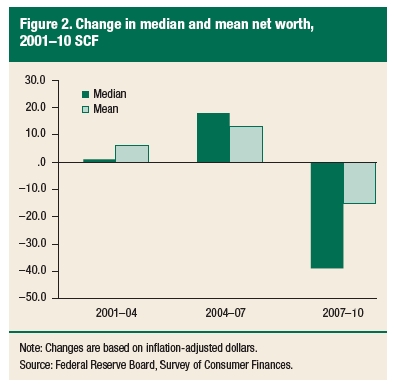
It started with a CNN article catching my eye – Family net worth plummets nearly 40%.  That article let me a to paper by the Board of Governors of the Federal Reserve System. This paper is titled Changes in U.S. Family Finances from 2007 to 2010: Evidence from the Survey of Consumer Finances. A report the Fed issues every three years. What I found interesting about the report and how CNN presented the information was that the report offered both Median (the family right in the middle) and Average (add up all families and divide by the total.) Indeed, the median fell 39% during this period, yet the mean fell less than 15%.

It’s not a simple matter to parse out the reasons for this sharp difference. One likely cause I’d look at is the drop in real estate values over this period. The report shows 2/3 of residential homes carrying a mortgage. As the median value of these homes dropped 18.9% and the mean fell 17.6%, the effect on the homeowner’s equity is magnified. The Fed report offers “If primary residences and the associated mortgage debt are excluded, the median of families’ net worth is reduced from $126,400 to $42,300 in 2007 and from $77,300 to $29,800 in 2010. Although the adjusted wealth measure declined proportionately by only a somewhat smaller amount than the unadjusted measure—29.7 percent— the amount of the change is, obviously, much smaller; median adjusted wealth declined $12,600, while the unadjusted measure fell $49,100.” This confirms my suspicion that real estate was a major factor.  Another cause is the demographic shift, new graduates coming into the job market at lower wages than they might have before the current economic troubles began.

An interesting report from the Federal Reserve, and not light reading, if you retrieve the article from the link above you’ll find an 80 page PDF dense with data that will take some time and patience to sift through. Next time, we’ll look at the changes in income over the same three year period.

{ 4 comments }

Today, a Guest Post by Kristy Ramirez –

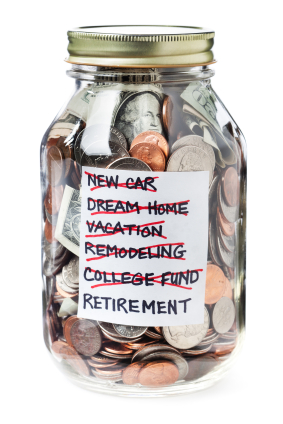
life savings penny jar

With the global financial crisis that our world is experiencing – beginning in 2008, and countries like Greece, Italy, the U.S. who are witnessing the collapse of their economic system, it’s no wonder we worry about where to put our hard earned cash. 

What is safe anymore?  

When we think about the crisis that put these countries in dire situations with unemployment skyrocketing, housing prices driven down to depression era values and more homeless people than ever before, not to mention the stock market crashes and losses of over 2 trillion dollars of retirement savings for so many, it’s unnerving to most people who want put something away for retirement, or a rainy day.

For Americans, the loss was catastrophic, with 401(k) plans dwindling, and an overall decline near 20 percent. So many people lost their live savings and nobody did anything for them. They have nothing to fall back on, and this event has been considered by the “WashingtonPost” to be one of the greatest casualties of the current financial crisis. 

Bankers are now looked upon as ‘the bad guys’, mostly because they are being blamed for all of this crisis due to their greed; selling off mortgages, taking bail-outs for their horrific and greedy choices, yet not reaching out to help their customers, but instead foreclosing and selling individual mortgages off to the highest bidder.

But – believe it or not, there are still some good banks out there, and fortunately they offer a safe refuge in which to save money, and earn a little too.  Remember, in the U.S. at least, your money is federally insured.  It wouldn’t be wise to put all of your money into one place; however, if you stay within the insured limits, spread out between different types of accounts, you are safe.

Here are some safe havens for your retirement, and/or savings:

Checking accounts:

Banks and credit unions offer interest-bearing checking accounts, and the best part is they are safe.  The accounts are insured for up to $250,000, so if the bank were to crash and burn, you’d get what you had in there, back. 

Of course the interest rates are not even worth mentioning, however, it would be wise to put a little aside here, just in case.  You have full access to your money at all times.

Learning to SaveSavings accounts:

These accounts are safe as well, as they are insured for up to 250,000.  Different banks offer different rates, and they are usually dependent on how much you actually have in there, however, you won’t lose everything should the bank fail.

Again, you have full access to your money should you need access.

Certificates of deposit:

These are also known as Term Deposit accounts, or TD’s and also CD’s. These are federally insured deposit accounts that you purchase in time increments. The maturity dates can range, depending on your choices, from weeks to years. And, of course the longer you invest, as well as the more you invest, the better the interest rate. These are safe and are offered by banks, brokerage firms and credit unions.

CD’s and TD’s offer interest income, with low risk, but cashing out can be costly if you do so prior to the maturity date.  So if you put cash here, make sure you won’t need access to it prior to its maturity.

The most prominent disappointment with these accounts is that the interest rate you purchase your CD/TD at is where it stays.  If you buy a 5-year CD – and the interest rates rise, you’re out of luck.   Consider this when looking into Time or Certificate deposit accounts.  Experts suggest buying 2 or three, and having them expire within a month of each other to avoid missing out on interest increases.

Money Market accounts:

A Money Market account is a form of a deposit account that pays you interests, and the rate, dependent on how much you put into it.  They earn higher interest than a typical savings account, but have different requirements, such as higher minimum balances and restrictions on withdrawals. 

These are very low risk, and are also federally insured, so you can’t lose your principal. Make certain that you stay within the insured levels that are at this point in time, $250,000, or you could lose your investment.  Be sure you check with your credit union or bank to verify the exact insured amount because it is generally $100,000.

The benefit of a Money Market account is that you are allowed to write checks (most are 3 per month) should you require cash, without penalty as long as you don’t dip below your minimum balance. 

Money Market funds:

savings bondsThese are quite different than Money Market accounts, because they are short-term investments that mature in a year or less.  The interest rates vary depending on risk, but generally they are safe because a low risk fund usually invests in Treasury securities, CD’s, federal agency notes and municipal securities, which are fairly stable.  Some even include government bonds, which have a history of being safe and stable. 

Money market funds are a bit riskier than a standard savings or Money Market accounts because they are securities, and are not insured, however they have been deemed safe as long as you stay away from the more risky funds.

The benefit of these funds is that you can write checks, and can sell or buy at any time. Plus you get your money (interest earned) in monthly dividend checks and the interest rates are much better than a standard savings or checking account. 

A very wise (and successful) investor once recommended that putting your ‘eggs’ in one basket spells trouble.  So don’t be afraid to spread out your savings to include many different accounts, and if you have a little to spare, try investing in more risky accounts such as higher risk mutual funds that bring high yields, to get to your goals quicker.

Remember though; don’t risk more than you can afford to lose.

Kristy Ramirez is a frugal mom and writer. In her time away from work she manages the family finances and is living debt free.

{ 0 comments }

A Wacky Impulse Buy Roundup

Our friends to the north aren’t immune to the same bad spending habits that we USers are prone to. Robb Engen offers some great advice to break these habits with 7 ways to avoid buying stuff you don’t need. Avoiding the impulse buys and spending money you don’t have is the first step to getting your financial life in order.

In a similar vein, Peter Anderson at Bible Money Matters asked Are You Behaving Like A Future Millionaire, Or Aiming To End Up Broke? He goes on to discuss the observations of Dr Thomas Stanley, author of The Millionaire Next Door and Stop Acting Rich, sharing some of the habits of those who have successfully accumulated wealth.

Next, a tax related article. I hate the alternative minimum tax (AMT). But I love the work of financial blogger Miranda Marquit. Her article A Basic Overview of the AMT was an excellent  introduction to how the AMT came to be, how it’s calculated, and what items make it worse for you. As always, nice work Miranda. If anyone in congress happens to be reading, please kill the AMT, it’s not just taxing millionaires, but hurting, well, the average Joe.

At Financial Wand, Jonny asks Is it worth applying for a 0% Credit Card? And as is often the case, it depends. Jonny suggests that its worthwhile as long as you use it for the right reason. Indeed. Read the article before you apply for another card.

My friend Len Penzo Just Made the Biggest Impulse Purchase of [His] Life (but It’s OK). And I have to say, he wins. My last impulse buy was about 4 years ago, a pair of tickets to see Sting. $600 at a local charity auction. Len’s purchase puts that sum to shame.

Iam1% declares that Money Does Buy Happiness. But it’s not what you’d think. It’s more about giving than getting.

And to wrap up this week, two posts on the Flexible Spending Account – Five Cent Nickel wrote IRS to Modify FSA Use-It-or-Lose-It Rule? And Kay Bell House OKs pro-consumer FSA changes, but they’re not likely to become law…yet. Two excellent articles about the potential changing in store for the FSA. I have a strange feeling whatever congress decides, it won’t make anything better. Only more convoluted.

Have a great week.

{ 1 comment }