A guest post –
Where one strong mind by itself can work wonders, two, working in tandem, can work miracles. If the relationship is done right, joint partnerships have the potential to take your business over the top and deep into the black. But joint partnerships can be tricky if they aren’t handled right. Here are ten tips to help you create the magic of a joint partnership that truly flourishes.

- Skills That Complement Each Other: Try to find a partner with skills that don’t overlap your own but instead complement them. If you prefer organization and accounting, look for a partner who will love meeting clients and being the face of the business. The most successful joint partnerships feature multiple individuals with unique sets of skills that complement each other and fit well together to create a complete whole. If you like being in control, bringing on board another person who likes being in control will only create conflict. Instead, find someone who is comfortable with allowing you to be in control.
- Relatively Secure Financial Background: It is usually unwise to pair up with a partner who has a shaky financial background. Doing the bulk of the heavy financial lifting while your partner only seems to tag along for the ride can get old fast. Make sure your partner is able to contribute his share of the finances to help start up your joint enterprise and that he doesn’t have any glaring financial monsters in his past that may come to stand in the way of your business’ future success.
- Equal Motivation: If you are a driven person, try to find a partner who is equally driven. Although there are exceptions, motivation is usually a quality that is hard to drum up if absent. If you find that you always have to drag a partner around by their hair or if you are always getting dragged around by a business partner who is more motivated than you are, your relationship and partnership will wear thin fast. Partner up with someone who has a similar amount of drive and enthusiasm as you, and you will both be happier.
- Similar Goals: In much the same vein, the goals of your partner and yourself must be somewhere in the same universe in order to create a successful joint partnership. There are many different kinds of goals, but at least when it comes to business goals, it’s best to find a partner with whom you are able to find some common ground. As long as you both are on the same page as far as the direction in which you would like your business to go, varying individual goals can more easily be tolerated.
- Shared Business Vision: Once you find a partner who has similar goals to yours, you must then make sure that they wish to go about accomplishing those goals in a similar manner. Two partners with similar goals and a similar vision for accomplishing those goals are practically unstoppable. Obviously you will both want your business to prosper, but if one of you wants to franchise and the other wants to sell the company to Microsoft, you may not be the best match for each other.
- Mutual Trust: Trust is supremely important in any successful joint partnership. You can’t work with someone who you don’t feel you can trust. A lack of trust will only create fires in the workplace and roadblocks to the success of your company. The importance of the trust factor is why so many successful partnerships are made up of brothers and sisters or husbands and wives. People who trust each other implicitly make much better matches, work much better together, and have much more success as a partnership.
- Job Roles: It’s important to define clear job roles for each member of the partnership so that nothing gets overlooked. It’s even a good idea to write down the roles that each partner will be expected to fulfil in order to maintain the highest degree of clarity. When you write down the responsibilities that each of you will be expected to perform, it helps to avoid frustration, disappointment, and the tragedy of crucial tasks falling through the cracks. Don’t operate under false assumptions about your partner or your business. Even if your partner is the primary salesperson, he may still expect you to bring in at least some business. When the job roles are clearly defined, each partner will then be accountable to each other and to themselves.
- Strategy for Handling Disagreements: Even the most successful joint partnerships will eventually and occasionally have disagreements. Make sure that these don’t turn into arguments or grudges by setting in place from the beginning a strategy for handling disagreements. The best partnerships are those that handle frustrations and disagreements effectively, wisely, and without any feelings getting hurt. Tailor your strategy to your strengths and the strengths of your partner so that both of you can come out of disagreements having made the right choices and feeling closer to and more trusting of each other.
- Communication: Often the only way to avoid bad feelings and disenchantment with your business partner is to have plenty of regular communication. If one or both of you is not the communicative type, it may be best to schedule regular times for communication so that the lines are forced to stay open. Having a communication session once a week or even once a month will allow you to bring up to your partner anything that may be on your heart about him. It will also allow him to address any issues he may have with you that he may be shy about bringing up on a regular business day. Don’t let your joint partnership deteriorate to the point that it becomes difficult to communicate with your partner, but schedule regular communication sessions right from the beginning.
- Break-up Plan: Even if your business ends up lasting your entire lifetime, it’s still wise to draw up a separation plan right from the beginning just in case. A break-up plan for a business partnership is much like a prenuptial agreement for a marriage. It will help you to both be on the same page about what will happen in the event that one or both of you wishes to terminate his involvement in the joint partnership. A break-up plan can help to give both of you peace of mind about the business even when it is going through a rough spot, as you will have a firm exit and asset-division strategy in place.
Andy writes about managing the relationship with money for Finance Choices, a UK based website where users can save money with a cheap balance transfer deal or interest-free credit card.
{ }
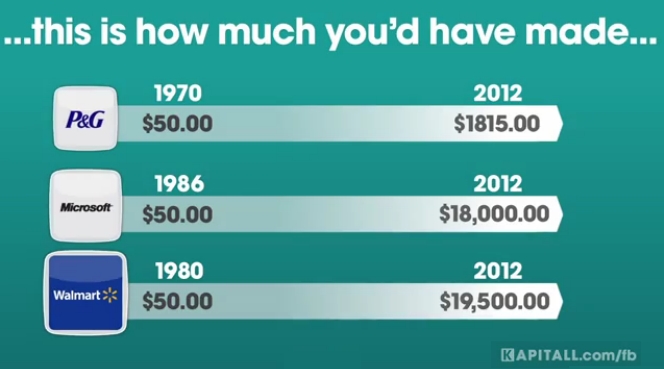
Lazy Man and Money starts the week with Kapitall: Facebook worth 36 Trillion Dollars? It seems the company Kapitall is comparing the return of Microsoft or Walmart over the years, suggesting that $50 invested at IPO would now be worth $18,000 in the case of Microsoft. But – Microsoft’s current Market Cap is about $270B. At IPO time, it was worth less than $1B. The Lazy Man simply did some math, and for Facebook to grow just at Microsoft did, it would have a value of $36 Trillion. Let me add, the total wealth in the world is about $200 Trillion. Can one company grow to nearly 20% of the entire world’s wealth? I highly doubt it. I think Apple is pushing its luck at over $1/2 Trillion.
From the very frugal Debt Sucks Cheap Scooter Repair With Plasti Dip. I’ve seen that stuff, but never bought a can. It may be time for me to give it a shot, I have a bunch of stuff I’d like plastic-coated.
Paula at Afford Anything asks How Much Money Is “A Lotâ€? I suppose it’s all relative, but it’s more than we start out thinking.
At Master Your Card, Using Credit Cards to Pay Insurance Premiums: Pros and Cons. Interesting article, but it all comes down to whether you are in the group that pays in full or allows charges to carry month to month and cost you interest. My simple rule? If you don’t have the money to pay in full, don’t buy the item. Insurance should be budgeted and made a top priority.
And to wrap up another great week of reading, at Graduated Learning, Stephanie wrote about Walk for Hunger: My first fitness+fundraising adventure. It was slow going at first, but after a few tweets and my pledging to match donations the first week, Stephanie has passed the $500 pledge level, let’s see if we can help her hit $1000 by the day of the walk (Sunday May 6th). Good luck, Stephanie!
{ }
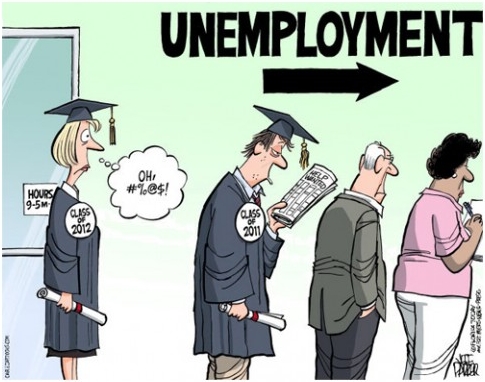
Another year of graduates finding a tough job market. A college degree doesn’t guarantee anyone a job. The data shows those graduating into a bad economy permanently lag those graduating into a good economy, on average.
{ }
A guest post –
A car is one of the most expensive items a family will ever purchase, and doing so can result in a significant amount of unforeseen expenses each month. For instance, one constant expense is gas. The cost of gas has recently placed a strain on many families, but it is possible that the cost of gas may continue to rise. Since auto expenses likely already eat up a huge chunk of your monthly budget, take the following measures to make up for any increase in gas prices come this summer.
1. Maintenance
Taking proper care of your car on a monthly basis is necessary to save yourself from financial disaster down the road. With proper maintenance, a car’s performance improves and you’ll often see this borne out in better mileage. For instance, get regular tune-ups. Tunes-ups help to ensure the car’s oil levels are at the right levels, the battery is in good condition and the spark plugs are working properly. If any of these items are not performing well, your car is likely to use more gas.

2. Tires
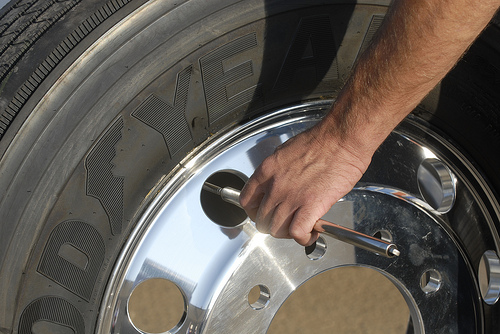
Another aspect of your car to take care of are the tires. Make sure that they are at the right pressure and inflated correctly. A tire that has the correct amount of pressure will result in less drag and resistance, saving gas. In addition, your tires should be properly aligned to prevent any steering problems. Shaking and trembling of the steering wheel while the car is in motion are common indications that there may be an issue with alignment.
3. Driving
Driving fast can be tempting, especially if you are running late. Â Unfortunately, driving fast or excessively accelerating can increase the amount of gas the car needs to consume. Maintaining a constant low speed is important to decrease the amount of gas used. It may also be a surprise to know that driving too slow may also cause more gas to be used, since there is more resistance to your tires. As a result, a steady and constant pace is the best way to maintain reasonable levels of gas.
4. A/C
During the hot summer months, A/C is often necessary while driving, but it can really put a drain on your gas. To prevent this, try driving with your windows rolled down. Or, turn the A/C off once your car has cooled. In addition, leaving the car on while waiting for your friend as they run to the store can have a negative impact on the amount of gas used. It is very important to minimize how often you leave your car idle.
Jason Arp likes to write about economics, saving money and frequenting www.lifeinsurancequotes.org
{ }
Len Penzo starts this week with 100 Words On: Why Buying in Bulk Is Not Always a Smart Idea. He’s right of course, you need to pay a bit of attention to the unit pricing. There are some items that turn out to be more expensive per pound in bulk than the lower sized price. My own experience is with Costco, where the items I buy are quite a savings from the grocery store price. Len’s message rings true – know what you are paying per pound or ounce and judge for your self.
At Deliver Away Debt the question is – Lawn Care – Cut the Grass or Hire It Out? For any homeowner, this is the question that comes right after “to be or not to be.” And each of us needs to decide what’s right. Me? I’d rather sub it out, the lawn guy does a good job and I’m able to keep my Saturdays to my self.

Paula at Afford Anything shares how her house jumped $100K from the last appraisal. Good news, probably.
At Financial Mentor, the question Pay Off Mortgage Early Or Invest- The Complete Guide. A detailed discussion of this decision. It’s not a no-brainer, there are compelling arguments to go either way.
Next, at Free Money Finance, Why The 4% Rule is Obsolete. The punchline is that FMF doesn’t care for the rule of thumb. I hear where he’s coming from. What I do know is that 8 or 10% is too high, and 2% a bit too low. Whether the right number is 4%, 5.5% or some other number can’t be known in advance.
And let’s wrap up this week with Kevin at No Debt Plan asking Why Wouldn’t You Consider a Flat Tax? You know what Kevin? I would. Flat is synonymous with “simple” and I like the idea of making the tax code less complex. Billions of hours spent each year learning and complying with the code, I think this is time better spent.
Today’s title? This week was the 35th anniversary of the release of the movie Annie Hall. The image above is of a print by the artist Al Hirschfeld which I bought right after I graduated college. 35 years? Time sure flies.
{ }