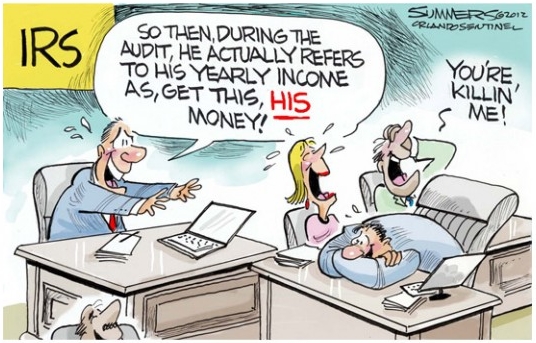
We like to poke fun at the IRS, and many point the finger at the IRS for our tax code. As tax day approaches, a friendly reminder, it’s congress that writes the rules, all 2500+ pages. U.S. Representative Rob Portman suggested that compliance each year takes 5.4 billion hours. This is 2.7 million person-work-years, a staggering number. The IRS is just the enforcer/collector, not the insane author of this mess.
The folk at Your Local Security (the website for the ADT company, for sake of full disclosure) have shared this article and infographic with the PF Blogging community.
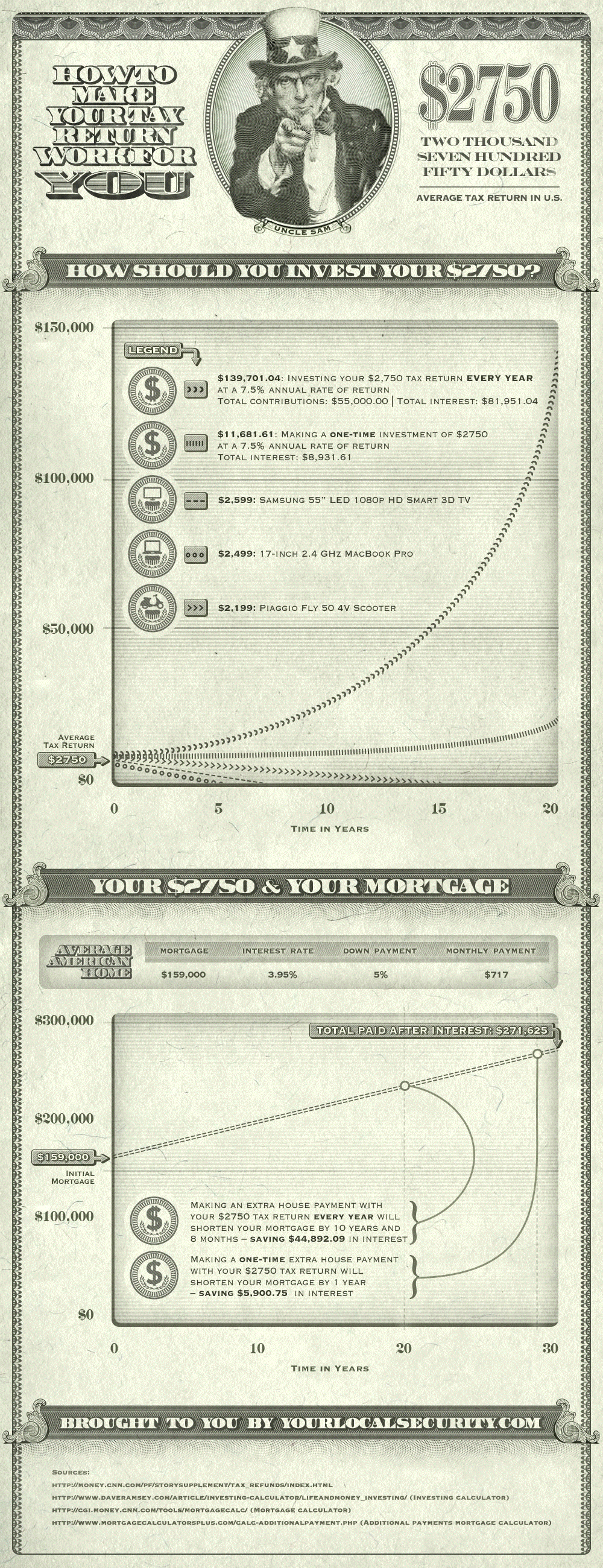
Every year we all have to pay taxes, and most of us get a nice juicy refund (especially those of us with kids!). Yet how many of us actually use our tax refund wisely? According to the IRS, the average tax return in the United States is around $2750! We decided to create this infographic to explore some of the most beneficial (in our opinion) ways one could spend—or not spend—his or her tax return. We hope you enjoy it, and I personally hope you put the advice to practice and start making some money off that return! Let us know your thoughts below in the comments, and remember to share this with your friends!
Note: You can click on the image to get a full, larger view.
If you’re like most Americans, you’re going to be getting a little bit of something back during tax season. The way our withholding system is set up, you’ll almost always overpay something in taxes and have it returned to you at the end of the tax year. When combined with tax credits, the end result is that most of us eagerly anticipate that check sometime between January and May.
If you’re hoping to use that tax refund sooner rather than later, there are some things you can do to speed up the process and get the IRS to cut you your check quickly:
1. Make the filing process quick and easy. You need to have a comprehensive tax strategy for your business, or even for your personal taxes. You need to have some idea of what your taxes are going to look like throughout the year. More than that, you need to organize and document your receipts, records, and expenses in such a way that, once tax time comes, you’re ready to file immediately. In many cases, you’ll just be waiting for employers to send a W2 or clients to send a 1099.
2. Understand current processing times. The IRS has, over the past few years, highly refined their filing process. From the IRS.gov website, you can now view current processing times. There’s a chart (and the format changes a bit from year to year) that shows on what date the IRS will send your refund if you file by a certain date. Typically, if you file by a certain Friday, you’ll receive your refund by the Friday that’s exactly two weeks later. In 2012, however, 2011 tax refunds were processed on Wednesdays, so you’ll want to check this each year. The bottom line, of course, is that the sooner you file, the sooner you’ll get your refund.
3. Make sure all of your information is accurate. Inaccuracies in your address or personal information are one of the most common reasons why a tax refund might be delayed. If you’ve moved since last year, you’ll need to update your address with the IRS. You can do that at the IRS website, or you can fill out form 8822. Either way, try to do this well in advance of the time you file your taxes so that it has time to work its way into the system.
4. E-file instead of paper filing. E-filed returns are processed much more quickly than paper returns. In fact, we’re talking about a difference of several weeks. E-filing will make sure you get your return much faster than if you file via paper. For most people and businesses, e-filing makes sense; you’re relying on tax software or a tax preparer to put your taxes together, and either should have the ability to let you E-file.
5. Choose direct deposit. If you e-file and choose direct deposit, you’re going to get your tax refund much sooner than if you e-file and request a paper check. The paper check can be delayed or – in some cases lost – in the mail system; a direct deposit goes through instantly and electronically. Once the IRS schedules the direct deposit, you’ll typically have your refund the next business day.
6. Consider an anticipation loan. If you need your tax refund sooner than a couple of weeks, you can look into a refund anticipation loan. This is a loan given to you typically by a tax preparer, and requires you to make the preparer a payee on the refund. They give you some or all of your refund amount in exchange for a fee. These fees can add up rather fast, so make sure you know exactly how much that anticipation loan is going to cost. In most cases, it’s worth waiting the couple of extra weeks.
7. Check on your refund status. While it won’t technically help your refund get to you any quicker, you can check on the status of your refund. The IRS offers a “Where’s My Refund?” tool that lets you get a status update on your refund. The site will typically show several days ahead of time when the IRS anticipates sending through a direct deposit or cutting a check.
Ultimately, it’s up to the IRS when you’re going to get your tax refund. While the normal processing time is usually just a couple of weeks, it could take two or three months. Doing some of these things will help expedite the process, but you’re still at their mercy.
Author Bio
Dominique Molina is President of the CertifiedTaxCoach.org, a professional organization that helps tax professionals deliver thousands in tax savings to their clients. Dominique has compiled many resources for members including a tax-specific engagement letter, the most comprehensive tax course in the industry, and powerful accounting marketing guides.
About 57 percent of U.S. citizens have health insurance through their employer and 29 percent get health insurance through a government plan, such as the military, Medicare or Medicaid. That leaves 14% of Americans without health insurance because they feel they can’t afford it, or are self-employed and can’t find individual health insurance plans. Some of the self-employed think they can’t afford coverage, and some have a hard time finding a policy because of pre-existing conditions.
Group and individual health care coverage
It can be more difficult to find individual health insurance plans than it is to get insurance in a group plan offered by an employer. When an individual applies for health insurance, that person’s medical history is examined closely whereas in a group setting, an insurance company may not look as closely at a person’s medical history.
If a person has a pre-existing condition, a health insurance company may not insure that person at all or may attach a rider to the policy stating that it won’t cover incidents related to the pre-existing condition. If at all possible, it can be better for a person to purchase health insurance before he develops a chronic health condition.
Shopping for an individual plan
When applying for individual health insurance plans, be sure to disclose any health issues. It’s also important to purchase only as much coverage as you think you’ll need, in order to avoid paying expensive monthly rates. Determine what insurance policy best suits your individual needs, and be sure to re-evaluate those needs when your marital status changes, or if you have or adopt a child.
If an individual needs health insurance and can’t afford it, or is having a problem finding insurance because of a pre-existing condition, a spouse could take a job with a company that offers health insurance benefits. The self-employed individual may still have a rider on the policy for pre-existing conditions, but he or she will still have health care coverage at a lower monthly rate.
An individual who is self-employed or unemployed has several choices of individual health insurance plans to choose from. An HMO is the most affordable option, but it can have constricting rules, such as using only doctors in its network. An individual’s doctor may not be a member of an HMO, and this could require someone to change doctors.
PPO plans also offer individual health insurance plans. With a PPO, an individual could choose any health care provider. An HSA, or health savings plan, often has a high deductible but reasonable premiums. It is also a tax-free savings account that an individual could use to save money for routine doctors’ visits and other medical expenses. A fee for service plan, or FFS plan, allows an individual to get the care he or she needs, then reimburses the individual for a percentage of the cost of the medical care.
When choosing a health care coverage plan, choose what works best for you and your health. The right insurance plan could save you money when you need it most.
This post is a guest post written by Ashley Spade, a law student in Chicago. In addition to learning how to live life on a grad student budget, Ashley spends her time training for triathlons and hanging out with her sidekick, Sir Winston Pugsalot (a rather mischievous pug). Follow her adventures on twitter @ashspade
This week, let’s start the roundup with S*** is F***ed up and Bulls***. This not safe for work article (actually, just the full title is NSFW, the content is great) is by Sam at Financial Samurai. It’s taken from the signs many of those Occupying Wall Street are holding. Unfortunately the occupiers aren’t really good at elaborating on the problems, nor suggesting the possible solutions. Sam, on the other hand will tell you, point by point what’s f’ed up, sorting the particulars by topic: government power abuse, taxation discrimination, human rights violations, integrity compromised, corporate abuse, and work & career injustices. A list worth reading, and you are a Wall Street Occupier, you might want to adopt it, and focus your message a bit more precisely.
Canadian Personal Finance Blog says Bye Bye Penny and Random Thoughts. Canada has lead the way, they have officially canceled the penny. Later this year they will stop minting new pennies. Will the US be far behind? Will the mint make them just for collectors as part of the annual coin sets? Will we miss them?
This week Miranda Marquit discussed How Much House Can You Afford? which is a great question. She offers some great guidelines to avoid going overboard, buying a house that’s a bit over the line.
At the Mighty Bargain Hunter, Talking about money? Please do! Somehow money has become a bit taboo, along with sex, religion and politics. There are things friends and family might choose not to share, but MBH feels it’s good to talk about money and I agree. There’s always something to learn, something to share when it comes to this topic.
And to wrap it up, at Money Help for Christians, When Helping Goes Terribly Wrong: The Risk of Giving. A personal story from Craig, with examples about how it’s not always easy to help others and get a good outcome. Helping doesn’t always turn out the way one would hope.