≡ Menu

Stretch IRA safe for now

First, what is a stretch IRA? It’s actually not an IRS term, but more like a nickname. It refers to the fact that an IRA inherited by a non-spouse can be withdrawn over the beneficiary’s lifetime. The beneficiary refers to the IRS publication 590 to find their minimum withdrawals which must be taken each year based on their age. For example, a 20 year old has a divisor of 63, which means his withdrawal is based on the prior December 31 IRA balance divided by 63 or just over 1.5% of that balance. The divisor drops by one each year, so this fellow will see that divisor drop to 25 a full 38 years later at age 58. 1/25 is 4%, so for all this time and years to come it’s possible the account will grow far faster than the withdrawals. Most important, taxes are only due on the amount withdrawn, so even a starting windfall value of $1 million requires a minimum distribution of $15,873 for this 20 year old. Now, for the news…

Just a few weeks ago, the Senate Finance Committee was reviewing a new highway bill and the committee chairman Max Baucus saw fit to tack on a provision that would eliminate the favorable terms for inherited IRAs. Spouses would be permitted to withdraw over their lifetime, as would the disabled. Minor children would also get the stretch, but older children or other beneficiaries would have 5 years to take their withdrawals. Even people of modest means could easily be thrown into the top tax bracket based on these forced withdrawals.

The story ends with good news, however. There was enough public outcry that the senate removed this provision.

I know that there’s a feeling that the inherited IRA favors the rich, but this is no different than any benefit. Mortgage interest deduction offers a higher benefit for a million dollar mortgage compared to a hundred thousand dollar mortgage. The capital gain rate assumes that one has such investments, and the rich are more likely to have stocks to take advantage of the cap gain rates. What the senate might have considered is a permanent fix to the estate tax, a reasonable exemption that most would consider fair, and as the estate includes retirement account assets, the stretch for beneficiaries can be left intact for good. It’s behind us, but only for now.

{ 1 comment }

The following guest article is from the folk at CreditcardCompare.com.au.

Every taxpayer, at some time or other, tends to feel that taxes are too high and long to live somewhere with lower taxes. For residents of five countries, in particular, that feeling is justified. To understand this, it’s helpful to look at the five countries where residents pay the most tax, and why taxes are so high in these countries.

These Countries are Extremely Expensive Places in Terms of Tax

Denmark (48.2%)

Denmark collects 48.2% of GDP in tax revenues, making it the most expensive country for taxpayers. The primary reason for this high percentage of taxes in Denmark is the country’s extremely large public sector. Denmark employs more public sector employees than almost any other country, at 30% of the country’s full-time workers. By comparison, the public sector in the U.S. makes up only 8% of full-time workers. The larger the public sector, the higher the tax revenues required to support it.

Sweden (46.2%)

Sweden follows closely on Denmark, with tax revenues at 46.2% of GDP. Sweden’s commitment to social services explain the high tax rate. All Swedes are guaranteed a fully paid education from age six, and a basic pension guaranteed to all citizens in their upper years. Heavily subsidized healthcare adds to the tax burden, but increases the social services available to Swedish citizens. On the other hand, Sweden has an elegantly simple tax collection system. In many cases, filing an annual return requires only a text message to the Swedish Tax Agency.

Italy (43.5%)

Italy falls third in the five highest taxing countries, at 43.5% of GDP collected as tax revenues. Like Sweden, Italy provides numerous social services to citizens. Pension payments alone cost the government 14% of GDP. Unfortunately for Italians, tax rates are probably about to go up as the government struggles to climb out from under staggering debt and balance Italy’s budget.

Belgium (43.2%)

Belgium practically ties Italy, with tax revenues reaching 43.2% of GDP. Belgium spends a great deal of money on health care for citizens. The Belgian constitution guarantees all Belgians’ right to health and the government pays for most of citizens’ healthcare. Belgians pay only a small fee for their healthcare. Belgian tax revenues also must cover infrastructure expenses and subsidies to various industries.

Finland (43.1%)

Falling fifth in the lineup is Finland, with tax revenues at 43.1% of GDP. Finland’s healthcare and social security systems are very good, and require a high tax rate to cover the government’s costs. The education system in Finland, which is also quite expensive, is considered the best in Europe.

Notice the Trend?

These countries are all European, with three of them being Scandinavian countries. Four of them are northern European countries, with Italy (currently struggling with its own sovereign debt problem) being the sole representative of the southern European nations.

Analyzing these five countries’ tax rates and the reasons for those high rates of taxation, one thing becomes clear. The five countries that tax their citizens most highly also return much of that revenue to their citizens in the form of social services. It’s worth noting that two of these countries feature in the list of ten best places in the world to live for maternity leave with Sweden and Denmark paying up to 80% and 100% of salary respectively according to “10 Best & Worst Countries In The World For Paid Maternity Leave.”

Caveats

There are some caveats to the observation that the taxation pays for human services.

Denmark actually employees 30% of the workers in the country, providing not only services but an income to those public sector workers. It could be argued that this large public sector workforce is motivated by the same spirit and ideals as the social services in the other four countries.

Italy provides generous social services to employees, like Sweden, Belgium and Finland. However, a portion of Italy’s tax revenues also go toward reducing the country’s considerable debt and balancing the budget.

Belgium does devote some tax revenues to infrastructure and industry subsidies, which contribute to higher taxes. The guarantee of a right to health, however, means that Belgium spends a considerable amount of its tax revenues on social services.

It is interesting to note that the countries with the highest tax rates seem to devote much of that tax revenue to providing services for citizens. This conclusion may be unexpected by some individuals who expect higher taxes to result in more government waste or spending on such sectors as military.

For those who might have originally been glad to not live in one of the five countries with the highest taxes, the benefits of citizenship in these countries may now be clearer.


{ 3 comments }

A Post President’s Day Roundup

Let’s start this week with Sustainable Life Blog’s Trade Borrow or Steal? An off-beat story of how the author’s office mates swap stuff. Elk meat, jam, beer, a whole lot of trading going on. Now, this may sound like bartering to the IRS,  but I wasn’t planning to tell.

At Stupid Cents, a guest post on the 5 Things That Have No Effect on Your Credit Score. I’ve written a number of articles on the componants of your credit score, it’s interesting to see what many assume impacts their score, but actually doesn’t.

One Frugal Girl asked Would $10,000 Change Your Life? I agree with her, that it would be nice to have an extra $10K, but it wouldn’t be life changing. I can’t help but think there are those for whom $10K would wipe out some high interest debt, maybe saving them $2K a year for years to come. For others, it might be seed money to start a new business.

Smart Money published 10 Things Prepaid Card Issuers Won’t Tell You. A nice article with some things that you’d expect about fees, rules, etc, but what caught my eye was the subtitle “Suze Orman and A-Rod are pitching these popular products, but experts say beware of the pitfalls.” Amen to that.

At No Debt Plan, Kevin wrote How I’m Saving 22% to 42% On My Mortgage Interest Through Refinancing. It’s pretty amazing how the monthly payments multiply and a bit of effort to refinance can save a huge chunk of the interest you’ll pay over the life of the loan.

And last this week, at Careful Cents, How to Use Balance Transfers to Save Money and Pay Off Debt. The Credit Card issuers are lending again, and many offer balance transfers for minimal fees and a zero interest rate. Taking advantage of these deals might save you thousands of dollars in interest over the year the zero rate applies.

{ 0 comments }

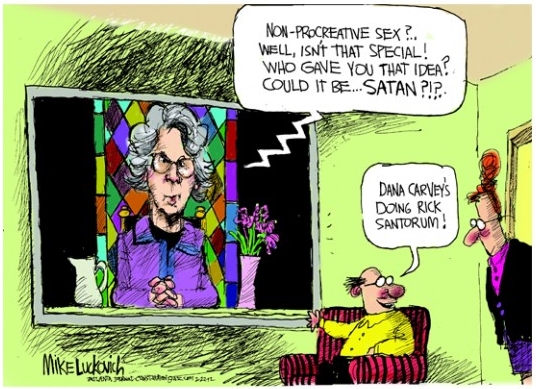
A Church Lady Cameo

Not sure if this is the Church Lady channeling Santorum, or vice versa,  but it does illustrate one of the reasons I don’t think Santorum makes for a viable candidate.

{ 0 comments }

Introducing a 1% Blogger

As my readers know, I follow other PF (personal finance) bloggers, both to learn, and just to see what they’re up to.

A new entry in to the PF blogs is I Am 1 percent, and so far, I’m finding him to be an interesting read. First, a step back. What does 1% mean? Commonly, it’s used to mean those whose AGI (adjusted gross income) is $350K and above. As far as net worth goes, it takes about $6M to be in the top 1% as of 2004. My new blogging friend’s net worth is near the $1 Million level.

As I read about “We, the 99%”, and the animosity toward the 1%, I wonder if the focus on the 1% is even accurate. This fellow (sorry, so far, I’ve not seen a first name, so I guess I’ll call him 1%er until I know better) has a story of growing up lower middle class, going to 6 years of school after high school, and getting into a decent field after graduating. He’s not gaming the system like those who have taken advantage of the financial markets, but seems to have earned his way to a decent income. His wife is also an educated professional, and her income is decent as well. They can make $350K or $400K, but to me, the greatest distinction is the fact that his income is earned, even options that he’ll get in his job are taxed as ordinary income. $400K of earned income will pay twice the tax as those who gross nearly $1Million/yr but get their money in the form of capital gains.

Funny how we group the 1%, as if a guy earning $350K in a regular job has anything in common with the $25 Million per year hedge fund managers. The super-rich are not sharing how their wives also work. Our 1%er vacations on the Jersey shore, and likes his credit card rebates as much as the rest of us do. It seems the way we develop any prejudice, the idea that we can draw a line and say who ever is over that line is different from you and me, is a bit silly, as we have more in common with this 1%er than he does with, what do we call them? Maybe the .1%? Either way, I welcome him to the family of PF bloggers and hope we can all learn from his story.

{ 9 comments }