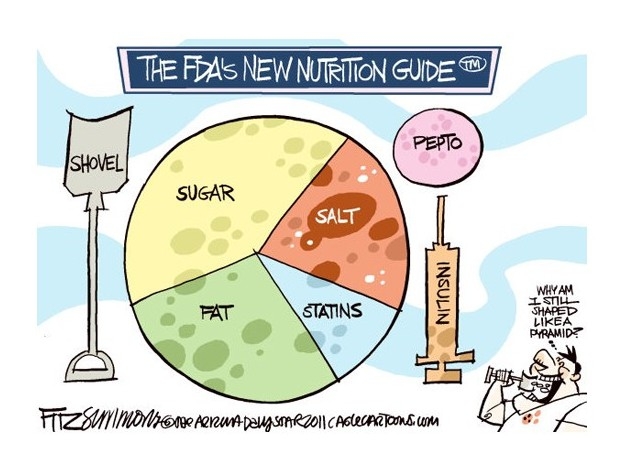
It seems the food pyramid has finally bit the dust for good. The government recommended high-carb diet along with high sugar and cereals probably did more to destroy the health of America as decades of medical research helped to bring us.
It seems the food pyramid has finally bit the dust for good. The government recommended high-carb diet along with high sugar and cereals probably did more to destroy the health of America as decades of medical research helped to bring us.
In October, 2009, I wrote The Unintended Consequences of CARD, and discussed how any limit on bank fees would result in them looking to replace that lost income elsewhere.
It took some time, but now I read Swipe fees give retailers a windfall of billions at the expense of consumers, which confirmed this trend is just starting. In this case, the story highlights how Wal-Mart lobbied to reduce swipe fees, the fees paid by merchants to tap into the debit card network. This seems to me to be natural, I’d like to pay lower fees for whatever services I get, why shouldn’t merchants do the same? The article’s author is Bill Cheney, president and CEO of the Credit Union National Association. His beef with this, is the credit unions which get this fee will seek to make it up elsewhere, and the consumer won’t see the savings at the register, the retailers will just pocket that money. Unintended consequences in action.
A week ago I wrote Dave Ramsey Scares me, for the fact that he forecasts the US stock market to grow at 12% as far as the eye can see and I think his disciples are ill-served by such prognostications. Over the past week, I thought some more on this. This is the same guy that talks about being debt free, paying the mortgage off as though it were a deal with devil. But wait a second, Dave, if I can borrow at 5% but get a 12% return on my money, why not just let that mortgage be, and start investing sooner? Let’s see what would happen if we did that.
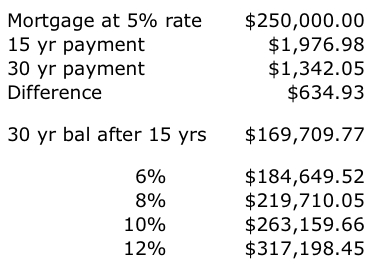
I tried to keep the numbers simple here. A 5% mortgage even though rates are actually lower right now. A $250,000 starting balance. Simple means I ignore the mortgage tax deduction, I don’t need it to prove the point. If we do the math, we find the difference in payments between the 15 year and the 30 year terms to be just under $635. If you go with the 30 year mortgage, you’ll still have a balance after 15 years of $169,709.77. This is simply the nature of mortgages, the balance is not linear, it can’t be. The interesting thing is that if you invest that $635 and get an annual return of 5%, after 15 years you’d have exactly $169,709.77, the exact amount remaining on the mortgage. Dave however, believes 12% is the norm, so let’s skip right to that line on the chart. At 12%, you have over $317,000 in your account. This isn’t just more than the remaining mortgage balance, it’s so much greater that if you withdraw just the amount due on the mortgage, it’s still growing faster than the withdrawals. Of course, 12% per year is 1% per month, and 1% of this balance is $3,170 against a payment due of $1342.05. (Note – I also showed the account balance if the market only does 6,8, or 10% vs Dave’s 12. Still, some impressive numbers.)
I know there’s a reason Dave doesn’t recommend this approach, I just don’t know what it is. I continued to do the math, no more money out of your checking account to pay this mortgage, it all comes from the saving that $634. After another 15 years, you’d have just over $1.2 million sacked away. I’d really like to know the flip side of this, how one can reconcile a 12%/yr forecast and the maniacal payback of this low interest debt.
Let’s start this week off with DoughRoller’s article Is Dave Ramsey Right that Credit Cards are Evil? Both DR and I are of a similar mind, the blame assigned to card use is far overdone. There are pros and cons to everything, and Dave’s “all or none” approach isn’t for all of us.
At Consumerism Commentary, Rob Bennett had an intriguing The Good Side of Stocks’ Lost Decade, which I read and understood. The premise is that for savers early on, this decade provides a lower cost. In 30 years time, look backwards, there will be a nice stock market price chart, and Rob will be able to say, “every purchase made during this bad time was made at a great discount to the trendline” and he’d be dead-on right. I, personally, am at the other end, where a sustained S&P 2500 would put me in a position to retire.
At Bible Money Matters, my Friend, (and the guy that designed my logo) Peter asked Is It Harder To Not Fall Prey To Consumerism When You Can Afford It More? Some great comments there, mine ended with “There’s an age/income/asset level that prompts the “you can’t take it with you†conversation.”
I think Gold is in bubble land, a financial accident waiting to happen for most gold gamblers. It seems Financial Edge agrees, with 5 Signs Gold Has Peaked.
A recurring question, this week tackled by LifeTuner, Is Paying Off Your Mortgage Early a Good Financial Strategy? The desire is out there, but the reality is far from the no-brainer many think it is. Read Chris’ article for more thoughts on this. (Note – no link, as the original article went missing)
I follow Lorie at Clutter Diet for some great tips on how to declutter my life. As many bloggers are quick to point out, clutter can cost you, so there really is a strong tie to one’s personal finances. This week Lorie’s article 4 Ways Clutter Can Kill Your Sex Life was getting some buzz on twitter (it was originally published in 2009) and caught my attention.
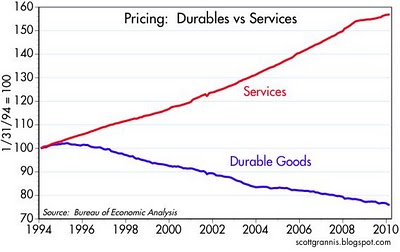
Last, another older post really impressed me – Balance Junkie’s Are You Ready for Biflation? A fascinating view on how we don’t live in a single economy, for the last decade the costs of goods and services haven’t risen at the same pace, in fact, goods have gotten cheaper while services have risen. Check out the article for a great discussion.
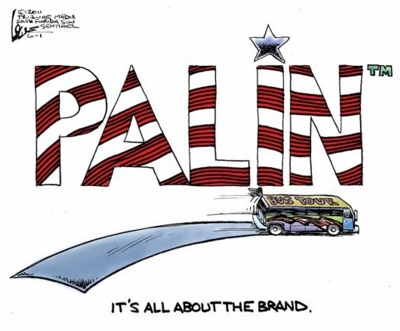 It seems like yesterday that I wrote Palin the Brand, a surrealistic image from a CNBC screenshot. But now it seems that both Sarah and her daughter Bristol have both submitted their names to get trademark protection. Yes, life imitates art yet again.