≡ Menu

How Old is Your Credit Card?

Last month I posted Too Little Debt, in which I discussed how a zero balance credit card bill is actually a negative to your credit score.

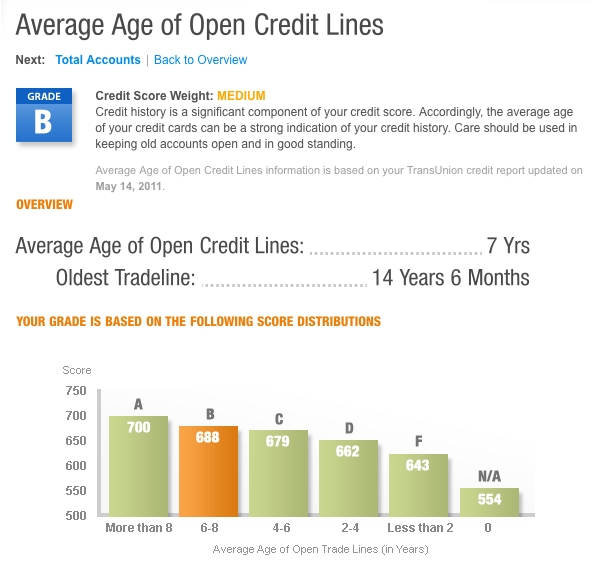
Today, I’d like to offer another aspect of your credit score – the Average Age of Open Credit Lines. Here, longer is better. This is one criteria that I really object to. Think about it, a card issuer decides to raise their rate or annual fee and you decide to get a new card from a different bank. If you had only that one card, you may be dropping your average time from many years right down to zero.

You can see from this chart, a snapshot from Credit Karma, that offers a view of the image of account age on your credit score. So, find a credit card or two with no fee and stick with it. Keep in mind, it’s simple math, if you have a few credit lines, adding a new one will have less impact on average time than if you only had one. You are also far better off canceling a more recent line than one that’s older than your personal average.  How old is your oldest card?

{ 2 comments }

Dave Ramsey scares me

Dave had published his expectations that the market would grow 12% on average and right until 2000 there was little reason to dispute this. Only, there was something wrong with Dave’s math even then. There’s a difference between the long term CAGR (compound annual growth rate) and the average return. Let me explain. If in one year, the market is up 20% and the next year it’s down 10%, you’d be inclined to add (-10+20)= 10, then divide by 2, for a 5%/yr average return, right? But, the way to calculate the CAGR is to take the returns, and multiply, 1.2*.9= 1.08. this is over 2 years, so you take the nth root, in this case 2, and get 3.92% per year. This may seem a minor difference, but it accumulates over time, and down years of say 33%, take a 50% increase to overcome.

Let’s look at the danger of relying on this magic 12%/yr number. First, if you wish to tinker for yourself, I wrote a small spreadsheet you can download to your computer. I start with the premise that (a) we shouldn’t count on Social Security, if it’s there in 30 years, treat it as a bonus. I also believe that 4% is the safe rate of withdrawal from your retirement account. This multiplies up to a requirement to have about twenty times your preretirement income saved as a lump sum, so you can withdraw 80% of your final income each year. Last I use 43 years of work, from age 21 to 63. When assuming a conservative 8% return per year, we find that we need to save 15% of our gross income. Not too crazy if you are dedicated to keeping your spending under control.

Now, if we run the numbers that Dave suggests, a 12% per year return tell you that you only need to save 5% per year. Wow, you think, I can really afford that, but 15% is crazy. You then find that after a decade like we just had, the compound return was a negative 1% per year. You see that by investing only 5%, you saved up about 42% (after losses) of your current income, and even if the market gets back on track, you still find you have only 15 times your final income. If the market return is a lower 8%, you retire with only six times your income, enough to withdraw less than a quarter of what you lived on prior.

On the flip side, by saving 15% as I suggest, even after this bad decade, an 8% return for the remaining time will put you at just under 18 times your final income, just a 10% shortfall. The reason Dave scares me is that even in my most optimistic days, I never assumed a 12% return long term. Not long ago, I wrote an article titled A Change of Plans, in which I looked at the S&P chart from 1980 through 2000 and extrapolate where it should have been 10 years later, in 2010:  3600, 4 times the value it actually was in 2010. Admittedly, I didn’t expect an entire decade to produce a loss, nor did I expect, as Dave did, to see 210% gains.

I’m curious what Dave’s followers did over the last ten years, have your expectations changed? Dave has only dug his heals in further, recently writing The 12% Reality. Sorry, I call it the 12% pipedream. Let me close with one question – would you rather plan for 8% and when returns are actually 12% or higher, find you can retire at 45 or 50, or would you plan for 12% and if the market stumbles even a bit, have to work till you are 70?

 

{ 10 comments }

A Post Playoff Roundup

Let’s start this week’s roundup with Sound Mind Investing’s How to use cash instead of credit and debit cards, an interesting discussion of one couple’s transition to using cash instead of credit or debit cards. While the cash-only life isn’t for me, I understand people have their approach to budgeting and avoiding overspending. If you’d like to try this approach, here’s a great article to get you started.

At Stupid Cents, Crystal guest posted, The Difference between Roth IRA and Traditional IRA, a topic that I never tire reading. She offers a great overview of these two plans.

Kevin M posts at Out of Your Rut and wrote an excellent piece this week, Five Reasons the 30 Year Mortgage Beats the 15. Kevin starts his article “I’m one of the rare examples of personal finance bloggers who see the 30 year mortgage as the better option than the 15 year loan for most homeowners.” Well, I’m right there with Kevin, I agree the 30 offers more flexibility and protection than the 15. On a personal note, my wife and I started with a 30 year mortgage, and refinanced to shorter terms as the rates fell and we paid principal, so the payment also fell. From beginning to end, we will have had 5 mortgages, no closing fees of any kind on the last 4, and will be paid in full by year 20.

JLP asked, Could you come up with $2K in 30 days? Which is interesting if only for the fact that for 25% of the population, the answer is simple, “No.”

At Money Crush, an article about Roth IRA for Children. If they have income, Roth is the way to go, I really like this idea.

And last this week – An actuary asks: Take Social Security early and invest proceeds? The choice as to when one should start their Social Security payments isn’t so simple. Nice piece.

Have a great week,
Joe

{ 1 comment }

Class of 2011

This seems to be a recurring theme this time of year. I wish the Class of 2011 well in their job hunt.

{ 0 comments }

Helping a Medical Marvel

Back in December, in my article “Charity Time,” I wrote about a Doctor who gave up her practice to form a clinic to help women who were homeless and couldn’t afford medical care. Yesterday, we received a letter from Dr. Means sharing some great news.

CNN has chosen Dr Means as one of their CNN Heroes / Medical Marvels. Toward the end of this summer, they will choose the top ten to each receive a $25,000 donation to their organization. This is where I am asking for my readers’ help. By going to the Facebook link and recommending her story to your friends, you can help her win this donation. It would be an amazing way to be part of a great bit of charity for no money out of your pocket just a few minutes of your time.

Thanks for the support!
Joe

{ 2 comments }