≡ Menu

The Housing Boom and Bust

A number of books have been written about the recent real estate crash over the last months. I’ve found Thomas Sowell’s The Housing Boom and Bust to be among the best.

house

Dr Sowell attributes much of the crisis to the well meaning politicians who misinterpret the meaning behind the data. They assume that any differences in mortgage approval rates between races must be due to racism and calls for correction. Instead of digging through the data to truly understand the origin of these differences, they seek to legislate equality with disastrous results. The Community Reinvestment Act (CRA) at its surface may have seemed to have the best of intentions, to provide affordable housing and improve home ownership rates among minorities. Unfortunately, good intentions didn’t lead to good results.

Let’s first take a step back and look at how the statistics are misunderstood. My undergrad is a BSEE (Bachelor of Science, Electrical Engineering), the number of women in my class and in the engineering school overall was about 15%. Does this need to be ‘fixed’ and if so, how? The immediate fix would be to change the acceptance criteria so all women that apply get admitted, or at least as many as it takes to get to 50/50. You can see how this is nonsense. For the long term, one can present fields of study in an interesting way and let the students decide. Can you change the interest of an entire gender? My data is 25 years old, and I suspect that the percent of women engineers has risen but not to the point of equality. This is a bit of a tangent, the truth behind the statistics, one I’ll bring up again in future posts.

An article in SmartMoney last November titled The Color of Money, spoke about the difference observed in wealth vs income among races, white households having a median net worth of $118,300 in 2004 vs black household’s $11,800. Even after normalizing for income, the wealth accumulation was higher for whites at the same income level as their black or Hispanic counterpart. The article didn’t go into the home ownership implications as it was pretty brief, instead focusing on retirement issues, but this observation sets the stage for some of the conclusions Dr Sowell’s book reaches.

The difference in mortgage approval rates can be viewed two ways, one study showing a denial rate for whites was 11% vs blacks 17%, ‘nearly 60% higher denial rate.’ When we look at the same data and state that the white approval rate was 91% vs blacks 83%, ‘less than a 10% disparity,’ the picture seems a bit different. What the CRA did was to encourage the banks to change the rules of lending, discarding much of what we learned in Mortgage 101. It wasn’t simply that house prices rose too high, as even in in 2005, the median house took just 22% of median income to afford, a number consistent with having housing cost 25% or less of one’s income. It was the introduction of subprime loans including those of the ‘no money down’ variety becoming the norm in many areas. This combined with the various adjustable rate products were the proposed solutions to a problem that didn’t exist. It doesn’t take a math genius to calculate the monthly payments required for an option ARM (paying interest only at a low teaser rate) and a fully amortizing higher rate loan a few years later. These products were the equivalent of financial time bombs.

This book is brief, only 148 pages, but an excellent read. The author, Thomas Sowell, is not a journalist with an agenda to promote, currently a Senior Fellow at the Hoover Institution, Stanford University, he has a respectable resume as a professor and author.

Joe
{ 15 comments }

This Week’s PF Blogger Roundup

This week let’s start with Bob at Christian PF asking Does Saver’s Remorse exist? It’s a great question, but a tough one to wrap my brain around. If I knew for certain (a) my future income stream, (b) the market return, and (c) the day I’ll die, I’d be able to plan things pretty well. I just pulled out a calculator to see what $500/mo invested over 40 years would turn into at different rates of return. At 4%, it’s $590.981, at 6%, $995.745, at 8%, $1,745,504, and at 10%, 3,162,040. The higher return will give you 5X the money you’ll get at the lower return in this range. This implies that you can have a target, but must keep your eye on the goal and change as time passes. If you assume a low return and have a lucky couple decades (anyone remember the 80’s and 90’s?) you may have saved more than you needed, but to count on 10% and then have a lost decade, well, ouch.

Jason at Redeeming Riches offers up 5 Dumb Mistakes That Smart People Make. A nice mix of observations ranging from Keeping up with the Joneses to not taking advantage of the 401(k) match. The list contains mistakes that are easy to make, but at the same time, easy to avoid. Take a read and see how many you’re guilty of doing.

Len Penzo is Not Cutting Up his Credit Cards, and neither am I. Len offers both sides of the debate, a number of great reasons why you shouldn’t use credit cards and a number of reasons why you should. In the end, the decision is yours, of course. Are the cards making your life better (added protection, extended warrantees, rewards) or worse (You can’t pay in full and the interest is just adding up each month)? One of the best pro/con credit card articles I’ve seen in some time.

JSWesey wrote about the Side Effects of New Credit Card Law. I wrote on this myself a few weeks back in The Unintended Consequences of CARD and JSW’s post is confirmation to me that card issuers are doing what they can to extract every dollar out of the consumer. The new law just has their lawyers rewriting the agreements to get fees from people not paying interest, or raising rates from those that do. (The link to JSW’s article is removed as the site is no longer valid)

And I’ll end this week’s best with the Fiscal Geek’s 10 Things Your Baby Doesn’t Need that Can Fund Their College Education. We do spoil out kids, and Paul is right, they don’t need a warmer for their baby wipes. And yes, my mother in law was right, my daughter didn’t ‘need’ a Bose Wave Radio when she was two. On the other hand, I had gift certificates to The Sharper Image and the life size Yoda would have just freaked her out.

Enjoy the week ahead,
Joe

{ 4 comments }

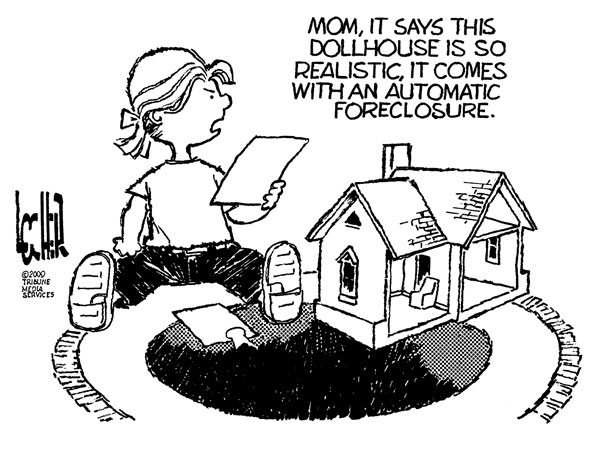
Realistic Toys?

toys

Maybe too real?

{ 0 comments }

Frugal Friday Week 25

As we approach the holiday season, it seemed a good time to discuss Gift Cards and why I care for them less and less. It started two years ago when I read a CNNMoney article that said 27% of recipients never used their gift card. Whether it was due to lack of time, selection at the card’s store, or a lost card, the 2006 unclaimed gift cards totaled $8 billion.

sharper

Shortly after, I wrote A not so Sharper Image in which I described how I found myself with $800 in gift cards that became worthless as Sharper Image went bankrupt. Linens n Things and Circuit City soon followed, and depending on the timing, most of the outstanding gift cards of these companies also became worthless.

In the old days (as when I was a kid), there were two choices for holiday gifting, an actual item, whether it be a toy, clothing, book, etc, or old fashioned cash. Sure, there was always the risk the clothes didn’t fit, the toy wasn’t age appropriate, but if the giver knew the recipient well enough, the gifts were good. When did we become so lazy or so disconnected from the target of our gifting that we decided it was better to tie the gift to one store and leave the effort to someone else?

If, by chance, you should be on the receiving end, a couple bits of advice. Be aware of your state’s gift card laws. Whatever you do, don’t put it in a drawer, use them quickly during the post holiday sales, and avoid the risk of finding an expired card years later.

You still have gift cards on you holiday shopping list?

Joe

{ 1 comment }

Traditional IRA day

Jeff Rose is a Certified Financial Planner who maintains a blog at Good Financial Cents. Jeff invited me to provide a regular guest post at his blog an I am honored to have the opportunity. The first of these posts Rules and Limits for the Traditional IRA is now up and I invite you to visit and read that article. With all the hype around the Roth IRA and the upcoming (2010) conversion rules change, the traditional IRA shouldn’t be overlooked.

Joe

{ 0 comments }