≡ Menu

A Guest Post today –

Treating your investments as anything less than a business is a mistake. Following advice of your broker isn’t always bad, but just like in business you should see a return on your investments and most brokers have interests that might not align with yours. If you have found yourself losing money, then you aren’t investing, you’re spending. Just like any business venture it’s essential to understand what brings success and success in the investing game is all about ROI.

A business cannot take major losses, and remain a business for long. Why would you be any different when investing your money? Brokers still get paid when you lose money, so excuses like “everyone’s losing money” or “it’s a bad market” are just that… excuses.

In business, having an employee consists of being able to utilize that employee in the most efficient way possible in order to maximize your return on investment. Think of your broker as an employee–can you afford him? I am sure that firing your broker isn’t what you want to do, but just like in business you can’t spend money if you aren’t making any.

Stocks are Products

Running a business comes from selling either a service or a product. In the personal investing side of things, it runs the same way. You buy and sell products (stocks) – in this case pieces of a company – in order to maximize the return on your money. Having a weak link, such as a bad broker or a computer that can’t keep up with the current trading software is costing you money, just like a bad employee would in a small business.

You Need a Plan

Every good company started with a solid business plan and every solid investment portfolio should utilize a plan as well. A business plan involves promotion, whether in the form of business cards, t-shirts or see these promotional products, a Nashville, TN company has to offer. Stock portfolios are essentially the same, only instead of promoting your business you are doing your best to promote your portfolio to hungry investors that’ll buy these stocks and make you some money in the process.

Set Goals

Another piece of the plan is goal setting. Make a list of things you want to accomplish. At what age would you like to retire? How much debt do you have and at what point does it need to be paid off? Which financial wants and needs are a priority?

Once you have solid goals, you can begin to calculate what needs to happen to get you there. For example, on a 7-percent annual return, do you need to invest 15-percent of your salary each year, or could you get there with 10-percent and wait to reap the rewards for another couple of years. Financial planners are great assets when trying to decide on your short and long-term goals, and they should be utilized unless you are an experienced and savvy investor.

Build a Team

Every business needs a good team to function. When investing, your team is essentially yourself, an accountant, a broker, and a financial advisor or consultant. The accountant is the easiest to justify a return on, as they keep you on track and help you navigate tricky tax codes and deal with capital gains. If you have previously experienced losses, he will help you to apply them over the next few years, thus saving you money right away. The broker isn’t going to show you a huge return (even with their “hot” tips), but they are a necessary evil unless you do 100-percent of your trading online.0

Now, the advisor or consultant is probably the easiest to calculate a return on. If you are solely relying on their advice, it’s pretty simple to calculate your annual returns, thus calculating the ROI from that team member should be a breeze.

Successful investors treat their portfolio as a business. They plan, they strive to make sound decisions and every dollar put in has to generate a return – not unlike a small business. Treat your investments as a product and get out there and start generating a return.



{ 0 comments }

Scapegoating Apple

Last week I wrote about The Senate vs Apple, my take on the what can best be described as a circus event in which Tim Cook, Apple’s CEO was questioned by the senate for a nearly three hours regarding Apple’s tax bill. I promised to dig a bit deeper and come back with more. Sometimes the exact word is lacking, but here, I think I got it right. Scapegoating: the practice of singling out any party for unmerited negative treatment. You see, what Apple did, wasn’t just legal, it’s common (and good) business practice. Here are a number of others:

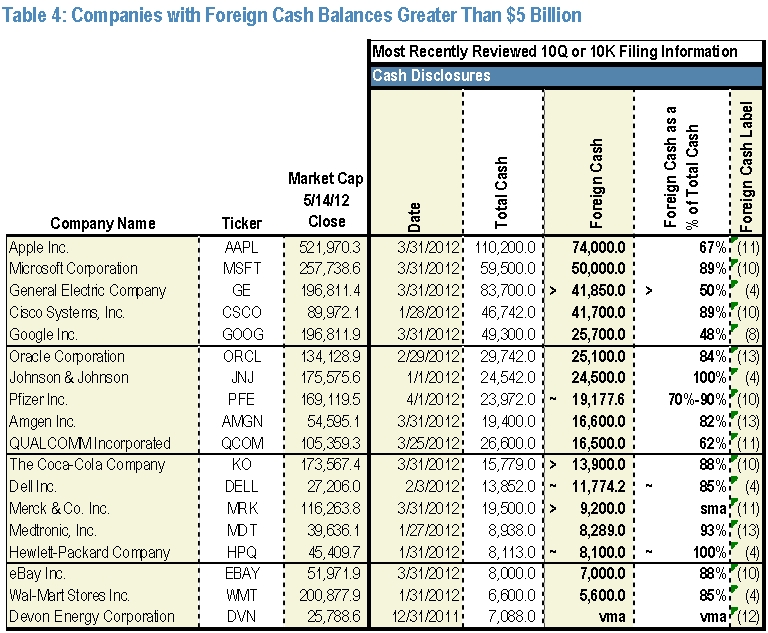
cashabroad

(sorry if it renders a bit small, you can right-click to open it to full size)

What we have here are the top companies holding cash abroad. Indeed, Apple is the largest, but it’s also the largest company in market capitalization. You can see that Microsoft’s cash held overseas is a higher ratio of both total cash they have as well as when compared to the total market cap.

I’m not a believer that “companies are people, too,” but I do believe that taxing a company more is the same as taxing people. These companies are held by all of us, if not as individual shares, then in our retirement accounts. A 35% corporate tax is enough reason for any of these companies to leave dollars earned overseas out of the US. The senate shouldn’t be grilling Apple’s CEO, but rather, Congress, who wrote the tax code. We can do away with much of the craziness with a number of changes to the code;

  • Bring the rate down for repatriated money. This money was earned overseas, taxed overseas, and can just as easily stay there. A 10% re-entry tax should be low enough to bring it back.
  • (If the above fails) – Offer incentives that any job creating expansion of local manufacturing plants will offset the tax on repatriated money, dollar for dollar. In other words, you build a $500M factory, you get to bring back $500M in cash held overseas.
  • The Fed has been printing dollars for years now, trying to turn easy money into an economic expansion. Why not offer a tax free repatriation of funds that will be used to pay dividends? How crazy is a tax code that encourages a company like Apple to issue bonds to raise cash to pay dividends while sitting on $74B tied up overseas? Cash paid out to US shareholders will help to boost the economy.

I have to add, I was disappointed to see very little coverage of this in the weekend news shows. Only CNN’s Your Money did a decent job asking “who is really at fault. Is it Apple for allegedly sketchy tax maneuvers or Congress for creating such a pliable tax code?” What do you think? Is Apple and these other companies going too far to cut their tax bill, or are they doing the right thing for their share holders? Will a low tax rate bring manufacturing jobs back?

{ 0 comments }

5 First Home Buyer Pitfalls to Avoid

A Guest Post for the potential new home buyer –

There are very few things more exciting (and exhausting!) than picking your first home. However, sometimes your enthusiasm and desire to get the best house money can buy can lead to some serious financial pitfalls. While you shouldn’t compromise on qualities that are important to you like how many bedrooms the home has, you should be flexible in other ways.

Before you head out to look for your dream house, consider these points to avoid the most common first time home buyers’ mistakes:

1. Not knowing what you can afford. The bank will qualify you for a home loan, but don’t trust what they tell you that you can afford. Often, they will qualify customers for more than they can comfortably afford. If you’re in the market for a new home, start setting aside the money for a mortgage payment now. For instance, if your rent is $1,200 a month, and you’ve been qualified for $2,200 a month mortgage payments, start putting aside the $1,000 difference each month. Do this for several months to make sure you can comfortably afford what the bank suggests. You might be wise to purchase less home than the bank says you can afford.

2. Failing to consider additional expenses. Too many buyers look at the cost of their mortgage payment as their only expense when buying a home. However, there are other expenses to consider–property tax, repairs and maintenance, private mortgage insurance and home owner’s insurance–to name a few, that can add several hundred dollars a month on top of your mortgage payment. Failing to plan for these expenses, especially repairs and maintenance, can you leave you short on cash or even worse, unable to afford your home.

3. Being too picky. First time home buyers are notoriously picky. If you’re on a limited budget, recognize that you may not be able to buy your perfect dream home. You may need to compromise to meet in the middle between the house you desire and the one that is available to you. Especially, don’t reject a house just because of cosmetics. Adding fresh paint and your own decorating touches can make a house much more attractive.

4. Compromising on the important things. As a first time home buyer, you shouldn’t let cosmetics discourage you from buying a home. However, you should remain firm on the structural elements of a home. If you have two children and want a three bedroom home, don’t settle for a two bedroom home or you’ll likely be unhappy and ready to move quickly. Likewise, if you want to buy a house that is close to your work so you only have a 15 minute commute, don’t choose a home that is one hour away from your workplace.

5. Don’t go through the process alone. Securing a mortgage and buying a home can be overwhelming and time consuming. Find professionals like real estate agents and mortgage brokers who can help you through the process. Mortgage brokers have a great deal of knowledge, and they can do much of the time consuming work for you. Best of all, most offer their services for free to the home buyer. Why navigate through the home buying process alone when there are brokers who can guide you through the process?

Buying a home is both exciting and overwhelming. Take note of these 5 mistakes first time home buyers make. Avoid them, and you’ll likely be happy with your new home for years to come, saving you the turmoil and expense of having to move quickly because you’re not satisfied with the home you purchased.

{ 1 comment }

A guest post today from Aunty –

There are several ways to invest in real estate.

Pants on fire!

The one that gets the most attention is buying low and selling higher for a profit. This is called “flipping” and this method is fast and exciting with potentially high rewards in a relatively short period of time.

There are some drawbacks to flipping, the biggest ones are not timing the market and getting too greedy. Many a successful investor prior to 2008 got caught with upside down properties that hit them hard and left them with bad credit and nothing to show for it.

For the savvy and hardworking:

There are also creative ways to get into real estate such as wholesaling, purchasing liens, tax deeds, subject to financing, etc., but Aunty has never really gotten into those – mostly because I didn’t understand them well enough, but also because I always wanted to be a landlord.

Landlord dream

This was a dream of mine ever since I was a little girl growing up in Palolo Valley clutching $100 in cash and flying through the backyards of neighbors to deliver it to our nice landlord. My mom was a hardworking single mother supporting a family of 4 kids by herself, money was tight, and $100 was a LOT of money in the 50’s. (Yep, Aunty is old.)

Homes in Hawaii cost about $30K back then, and the ROI (return on investment) for a landlord would have been 4%. Not that great a return? Maybe not, but it was solid steady income, especially for a 7 year old who couldn’t believe the abundance in her hands as she ran through shortcuts to deliver this fortune into the hands of a landlord. [*note about ROI – this formula is an annualized return of monthly rent x 12 months divided by cost.]

Appreciation and rents over 50 years

Hawaii’s real estate appreciated over the years, and 3 decades later, in the 80’s, a house in Palolo would cost $120K, rents would have gone up to $400/month, and the ROI would have been 4%, with an appreciation of the original asset at 400%.

In the late 80’s, Hawaii house prices soared and soared even more in the 1990s. It was like a huge bubble that didn’t pop. It retraced a little, but never came close to mid 80’s prices.

Today, an average house in Palolo would sell for $600K. Palolo is an interesting neighborhood of older wooden houses with a spattering of huge new houses nestled into a valley with a couple of low income housing complexes. On the other side of the mountains is Manoa Valley, a verdant valley of wealthier residents with older larger homes in the $1+ million range.

At $600K, the average Palolo house has appreciated by 20 times its original value of 60 years ago. Rents have increased to about $2000/mo. ROI based on today’s FMV (fair market value) would be 4%. ROI based on 1980’s prices would be 20%. ROI based on 1950’s prices would be 80%!

[Please forgive Aunty’s overly simplified numbers – they are not taking into account monthly expenses that would offset rental income lower, and they are based on an all cash purchase of a property.]

Adding a mortgage to the mix

However, if the property was mortgaged at 70% LTV (loan to value), then the cash down portion of the investment, which is the amount of your investment drops to 30% of the cost of the property.

In 1987, if you could get a 70% LTV with a 10% annualized interest (loans had higher rates back then), you would have a negative ROI of on a $120K house bringing in $400/month in rental income because you would have a negative monthly cash flow of $800. Your cash basis would have been $36,000 with a -26% ROI.

Today, if you could get a 70% LTV with a 4% annualized interest, you would still have a negative ROI, and a negative monthly cash flow of $2400. Your cash basis would be $180,000 with a -16% ROI.

What does that mean?

Hawaii is not a cash flow income-generating place to invest in unless you have a huge chunk of cash to purchase and you will be satisfied with a 4% annual return on that cash, or you bought a while ago and your mortgage has been paid off.

It also means that Aunty does not invest in rental income properties in Hawaii, because these options and numbers are not good.

What to do?

If one does want to invest profitably in today’s Hawaii real estate, the modus operandi is buy and flip – but carefully, with good market research and reliable resources for rehabbing.

Or, look for better markets that have better numbers for investing. Places such as Indiana, Las Vegas, and other cities that have low property values and moderate rental incomes that give very decent cash flow and higher ROIs (10% or better!)

No more yesterday

Slowly and steadily, we are building a real estate portfolio, but not in Hawaii. Perhaps later, if and when it makes sense to do so.

Gone is the little girl who would fly on skinny legs to complete her most important task of delivering rent each month. Today’s scene includes a property manager who takes care of everything. Automatic deposits and debits in an investment business checking account replace the hand-to-hand payee/payer transaction that first sparked the aspiration, “I am going to be a landlady one day!”

Is real estate investing the best investment vehicle? I cannot say for you, but for Aunty, it fulfills her lifelong dream. Have your got your dreams, your success?

Whatever you dream of, may it be.

Note: Aunty is the gal that blogs at Honolulu Aunty where she writes on a variety of topics, money, recipes, travel, and a good half dozen more.


{ 2 comments }

A Mega Potato Round Up

It’s that time of year again, graduation time. And that’s why today’s round up starts with The Most Important Piece of Financial Advice for College Graduates. I’m not going to spoil the punchline, but I will say, I agree with the article’s advise, and college grad or not, you’ll be a bit wiser for reading it as well.

megafries

Above is an image of the new sized fries that are soon to be sold in Japan. It weighs in at 350 grams (just over 3/4 lb) and will sell for 490 Yen ($5 or so). Rumor has it that Mayor Bloomberg is already planning a to launch a pre-emptive strike, writing a law limiting the size of a portion of fries that can be sold in New York City.

The Weakonomist asked Has The Recession Made Us More Informed About Economics? I was asking a similar question after the crash of 2000. And of course I remember the banking crisis of the early ’80s, you know, the Resolution Trust Corp? But I digress. We’ll see if this generation learns any of lessons the prior ones missed.

Next, the Debt Princess tell us What NOT to Do: Live in Denial. It seems the Princess has made a few mistakes and she’s working to right size her financial life. Jessica writes from the heart, and writes in the hope that her story will help others to avoid the mistakes that she’s made. An article that might help you look at your own choices more closely.

Kay Bell offered her take on the Senate’s Inquisition of Apple’s Tim Cook at Apple lauded on Capitol Hill at hearing about its low U.S. taxes. Kay’s not quite as sympathetic to Apple as I am, but I offer her article as a counterpoint to my opinion, and because Crossfire is no longer on the air.

As much as I love a bargain, and often fill a space in the closet with half price laundry soap or TP, it’s good to know What NOT to stock up on in your stockpile! An excellent tutorial at Couple Money on the items you should buy with caution.  I agee with the caution on buying too much fish, meat, etc, so keep an eye on your supermarket sales cycle, usually six weeks from one chicken sale to the next.

And to wrap up the week, at Money Under 30, Can In-Store Health Clinics Save You Money? I’ve found the Minute Clinic at CVS to be a great service, a time saver for me and a savings on the system. No need to go to my doctor’s office for a flu shot. Have you visited your local drug store clinic?

{ 2 comments }