≡ Menu

The Internet Sales Tax

internettax

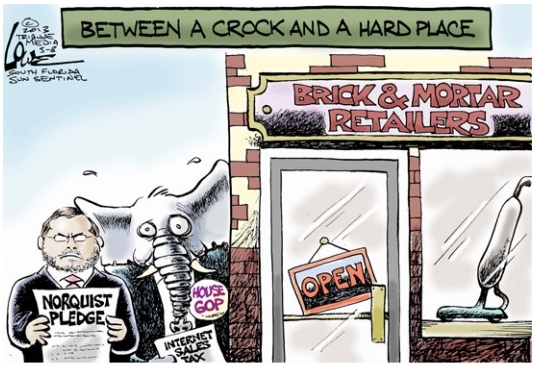
This week congress passed legislation requiring on-line stores to collect sales tax  based on the buyer’s state of residence. This really isn’t a new tax, when you buy an item from an out of state vendor, you are required to pay your state sales tax when you file your tax return. It seems no one ever does, so this was simply a matter of enforcement.

{ 3 comments }

Soylent Green

It’s remarkable to me how time passes. I don’t ponder this every single day, but when I am reminded of a movie or other event from my childhood, I can’t help but take a step back and reflect. I don’t know what I was looking for online but I ran across a web page describing the movie Soylent Green. And with perfect timing my daughter walked by, glanced at my screen, and ask what’s “Soylent Green?”  Now, you’re either laughing along or shaking your head, no idea what I’m talking about.

soylent_green_crackers
It was 40 years ago today that Soylent Green was released. The action takes place in New York City, where I lived but set in 2022, which no longer seems so far off. The population has exploded and NYC grew to an insane 40 million (from the 7 or so million at the time) and food was in short supply. As a 10 year old who was both a fan of science fiction and aware of the issues that faced the world, poverty, hunger, over population, this movie made an impression on me.

1973 also produced Westworld, “Where nothing can go worng,” The Exorcist, which I wish I hadn’t seen at 10, and Ralph Bakshi’s Heavy Metal, an animated movie that got an X rating. I’ve been meaning to see it, still.

{ 7 comments }

Stupid Tax Tricks

After I wrote The Step Transaction Doctrine at my companion site, RothMania, I received a number of emails asking about situations where this might apply. Here’s an example of another disallowed series of transactions:

A) A son and wife are in a high tax bracket. Enough so the AMT effect causes there long term capital gain to be taxed at 22.5% (really 15% plus extra due to AMT). They gift the son’s parents $50,000 in appreciated stock.
B) The parents, who are in a low bracket, sell the shares and have no tax due as there’s no cap gain tax if you are in the 10 or 15% bracket.
C) Parents then gift their son and his wife $50,000, the proceeds of the sale.

stupidtaxtrick

In a Q&A a few years back my favorite IRA author Ed Slott offered a definition of the Step Transaction Doctrine:

The step transaction doctrine can be a bit complicated, but essentially, when applied it treats what are actually several independent steps as if they were a single transaction for tax purposes. 

There are three different tests which have been used to determine if the step transaction doctrine should apply. One test, commonly referred to as the “binding commitment test” applies when there is a commitment to complete a later step in an overall transaction at the time the first step is made. Since an IRA contribution (deductible or not) does not require that one convert the contribution to a Roth IRA, this test is a non-factor here.  

Another test that is used to determine if the step transaction doctrine should be applied is the “mutual interdependence test.” This test looks at each step in an overall series of steps and determines if a specific step is meaningless unless the later step(s) actually occurs. Since a non-deductible IRA contribution is clearly beneficial (read “not meaningless”) on its own, this test is also a non-factor.  

The third and final test, known as the “end result test,” is the most applicable for this discussion. Under the end result test, the steps in a transaction are looked at to see whether the series of steps were really just predetermined steps of a single, overall transaction, aimed at achieving a specific outcome. Do clients make IRA contributions with the idea that they will later convert them? Sure. So is it possible for IRS to raise issues with this strategy in the future? Yes, but it’s not a likely scenario.

You can see that each of these events, taken alone, is perfectly legitimate. It’s only when they are combined in this way that the IRS combines the transactions and would go back to our Yuppie couple along with a tax bill.
The key thing to ask yourself is whether each event was legitimate, and in this case, there’s really no bona fide gift to anyone, the transactions are simply tax avoidance. Will you get caught? That’s the wrong question. You see, once you start asking what your chances are, it’s a slippery slope. Best to avoid deals that look like this regardless of what your ‘advisor’ tells you. At RothMania, a reader’s brother has a tax attorney who was encouraging him to skirt this rule, either that or the lawyer was completely ignorant of it. In either case, I’d stay clear of any advisor who makes such proposals.  If it sounds too good to be true, it might just be tax evasion.

{ 0 comments }

The Fraud Game: Checks Versus Card

A guest post today from Annie Harrington –

Back in 2003 under a study conducted by the American Bankers Associates, some alarming data was presented. According to the study, check fraud was becoming an epidemic. Information found through the study suggested that more than 1.2 million fraudulent checks were being circulated throughout the United States. These numbers were not over the course of a year, a month or even a week, but instead in one day. Even in 2003 when the advent of the debit card was beginning to take off and check usage began to see its initial decline, fraud was still on the rise. What was worse, it was expected to grow steadily each year by about 2.5%. But now, let’s flash-forward to 2012, last year. For the first time ever that 2.5% was finally culled and instead of growing, it dropped 7.5%.

But, under the tried and true theory of checks and balances (no pun intended), when one thing falls, another must rise and rise it has. As check fraud began to die down, the United States began to notice an upswing in other kinds of fraud, mainly that related to debit and credit card. In another study conducted by the Consumer Sentinel Network (funded by the US Department of Justice) research showed that 17% of Americans have been the subject of either credit or debit card fraud. While the quickly becoming antiquated check fraud was largely tied to the writing of fraudulent checks, debit and credit card fraud has several different pitfalls to which a consumer or business can fall victim to. Here are the top five for 2012.

Counterfeit credit cards 37%
Lost or stolen cards 23%
Account information compromised (dubious telemarketers, key-loggers etc..) 10%
Stolen cards through mailing fraud 7%
Identity theft fraud 4%

While the initial 2003 study from AMA was true to a point, check fraud crime made its peak in 2008. In the years leading up to 2012 there was an incremental decline but nothing as large as the 7.5 drop, which marked the biggest turn in the right direction for some time. But, what can we take from these numbers? Can we take the data and make an overarching statement about fraudulent crime as it relates to card and checks?? Have increased security measures and more sophisticated technology deterred would be thieves from taking advantage of check crime or have they simply put their efforts into card related crime? It’s difficult to say.

The use of personal checks has been declining each year. More and more people are opting to pay their bills online, use a card to pay for their groceries, gas and other items. But this isn’t new, shocking news. Debit and credit cards have been being used for quite some time. Since 2012 was the first year where such a noticeable decline in check fraud was noted, most experts are waiting for the 2013 statistics to see if this will be a trend or an anomaly in fraudulent behavior.

Let’s take a look at total amounts lost across both platforms. Even at its highest peak in 2008, check fraud was nowhere near the estimated amount lost through debit and credit cards during last year’s reporting. In 2008, check fraud accounted for a little over 1.02 billion dollars in lost funds. This number is by no means a small amount, but when put up next to the amount of money lost through debit or credit card fraud, an ample $190 billion, it almost seems like chump change.

So to answer the question posed earlier, are the days of accounts being compromised and malicious financial behavior behind us? Sadly, they are not. So, for the consumer who is looking for an immediate answer with the data on their sides, it appears that checks, while quickly becoming a thing of the past, or still the more secure method of payment.

In order to combat these escalating figures card companies have teamed up to make what is referred to as the EMV initiative Cards using this technology will incorporate a small chip that will step up authentication measures, hopefully ensuring that the right person is using the right card for the right reasons. While there has been a bit of backlash among some on account of these chips violating personal freedoms the EMV movement is instead focusing on the immediate benefit that would see that 190 billion dollar black hole become just a bit smaller.

In order to entice companies over the system, the EMV initiative will cover and financial losses for the companies when a card is put into the wrong hands, a deal that is becoming very attractive to the likes of Visa and Mastercard. This protection from losses officially goes into effect in October of 2015.

Annie Harrington is a small business owner and freelance writer. She is also keenly interested in all aspects of design and the design process.

{ 1 comment }

A Cinco de Mayo 2013 Roundup

Cinco de Mayo is not Mexican Independence Day which is on September 16. It was first celebrated as a way to commemorate the cause of freedom and democracy during the first years of the American Civil War,and today the date is observed in the United States as a celebration of Mexican heritage and pride. Just saying.

Earlier this week I wrote about the Frontline Report, The Retirement Gamble. My friend and fellow blogger Roger Wohlner, The Chicago Financial Planner, also wrote about this program at My Thoughts on PBS Frontline The Retirement Gamble. My opinion and Roger’s a re close but not identical. Check out his article for his take on this program. The Investor Junkie also offered his view at Are Retirement Accounts Flawed? If nothing else, a PBS show like this will get people’s attention. I hope it’s for the better. An unintended consequence would be for people who are too lazy to even check their fund expenses decide that they won’t bother depositing. Or that those with a good company match will lose that match in a misguided effort to avoid high fees.

Cinco_de_Mayo_1901_poster

Sometimes Len Penzo offers a quirky article not quite related to finance. This week is was 100 Words On: Why It’s Not Poor Etiquette to Put Ketchup on a Hot Dog. As I commented to Len,”Fortunately, we live in the US, the land of choice. You are free to do some pretty awful things, and ketchup on the hot dog is one of them. In the not-so-free countries, you’d be handcuffed and taken away for this offense.” To me it’s not a matter of etiquette, it’s a matter of not being gross.

At Budgets are Sexy, J Money tell us the Things I’d Tell My 20 Year Old Self… If only we could go back in time and change one or two things. A few good stock picks, perhaps? This article left me thinking, I’ll have to get back to you.

In contrast to Paula’s If Everyone Jumped Off a Cliff article a few weeks back, Kyle at Amateur Asset Allocator asked If Everybody Indexed, Would It Stop Working? An interesting thought and Kyle offered a great discussion and analysis of the effect that indexers have on the market. More than that, he slipped in the phrase raison d’être, which raises the quality of most articles, save for those advocating ketchup.

I never tire of the great mortgage debate, and guest posting at PT Money was Emily Guy Birken with Pros and Cons of the 15 vs 30 Year Mortgage. There’s no right or wrong answer, in my opinion. I’m in favor of the 30 year, but if there were just one right choice Emily made a strong case for the 15. That’s one of the great things about the PF Blogging community, we’re opinionated but open to new ideas. Check out Emily’s article and the comments it’s been getting.

At My Financial Independence Journey, a look at What’s your financial independence (retirement) number? It’s a great question, with no two people having the same answer. (Not quite true, I’m sure there’s overlap) I am sure that each person’s situation is unique and they come to their conclusion their own way.  In this case the comments are as revealing as the article itself. Have you thought about your number, the amount that you need to save to afford to retire?

{ 2 comments }