≡ Menu

Congress and the Tin Man

tin-congress

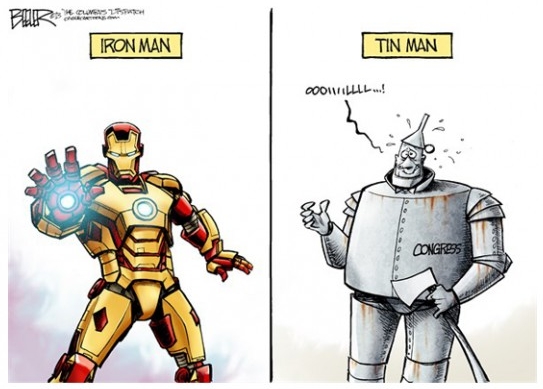
Today is May 4th. May Fourth, as in “May the Fourth be with you.” Cute, but Star Wars was released on May 25th, so when someone uses that line I look at them and say,”You’re three weeks early.” Worse, I couldn’t find any tie-in to finance or politics and Star Wars. But, yesterday was the release of Iron Man 3 in the US, and I am a fan. I remember when comics were the downfall of society, and it’s been downhill from there.

A nice Iron Man tie-in along with an insult to congress. Is there a connection with the Tin Man having no heart? You decide.

{ 0 comments }

Frugal Friday Week 39

If you don’t know it, I am a Costco fan. As with anything, people love it, hate it, or don’t happen to have one nearby, and therefore, don’t care. Countless articles on what you save at Costco vs what you’d be better off buying elsewhere. Hint – know your unit pricing. That said, my daughter asked me to print and pick up a few pictures for her to give as a gift. A bit short notice to me, she found picture frames over the weekend, and sent me the pictures to print with a day’s notice. I like CVS, and pass the local CVS pretty often, so I sent the digital pictures to CVS for printing. 19 cents each, not too bad. Until the fine print – “Orders under $5 subject to $1.49 surcharge fee.” So, the choice was to pony up $1.49 or go elsewhere. Here’s the thing. I am 10 miles away and a 45 minute round trip to Costco. So spending $3.50 in gas makes no sense, and CVS it was. It would have taken 27 pictures to hit the $5 minimum. Do people print that many pictures at once? In the old days, it was $12 or so to print a roll of film, 36 pictures, and pick out the two good shots for the photo album. Today, with digital pictures, we no longer print bad shots.

That said, let’s look at the photo cost of CVS and Costco. First, Costco –

costcopix

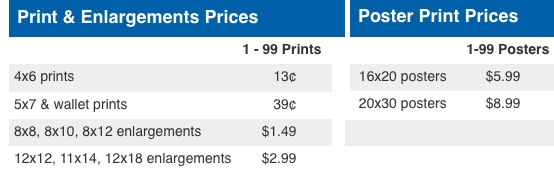
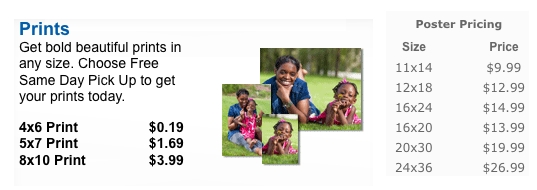
The 4×6 pictures are a bit cheaper, 6 cents, in fact. No big deal there. Let’s look at CVS and compare the rest –

cvspix

If you have a collection of 5×7 frames in your house, it’s 39 cents vs $1.69. Over 4 times the price at CVS. Plus the surcharge if we only need a few pictures. I also included the next sizes to compare 8×10 and the poster sized prints. I had a function last year, and wanted to print a 20 x 30 poster. Not being an artist or having any aesthetic skills, it took a few tries to get it right. So my Costco tab for 5 posters was $45 compared to the $100 it would have cost at CVS.

For those who are into photography, these price difference add up fast. I don’t spend that much in an average year on photos, but the savings still adds to my list of reasons I like Costco and find the membership worth it.

Do you have a Costco or other warehouse club membership? Are you happy with your saving?

{ 3 comments }

Lying With Charts 101

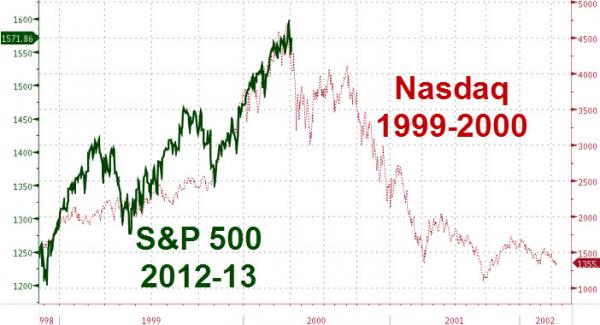
Decades ago, I read a book titled How To Lie With Statistics, and I was reminded of that book when presented with the graph below, posted at Zero Hedge and titled Party Like it’s 1999?


SP_nasdaq

The graph is intended to draw a similarity between the current S&P run-up and the Nasdaq run-up and ensuing crash. A scary coincidence that makes you want to sell right now? Or someone who’s fairly adept with charts pulling a visual fraud?

Have you caught the Big Lie yet? You see, the move from 1250 to near 1600 on the S&P is about 28%. In comparison, the Nasdaq move took it from about 1500 to 4500, a 200% increase. You can easily take any move in the market and with a bit of manipulation, create a chart as you see above. The key in this case is the two different scales,  the S&P on the left, Nasdaq on the right. Had the charts been produced using the same scale, they’d show no resemblance to each other.

I’m not making any prediction where the market is heading, only suggesting that when you see a chart, any chart, look carefully at the scales, and don’t let the author fool you.

{ 11 comments }

A Guest Post from Crystal –

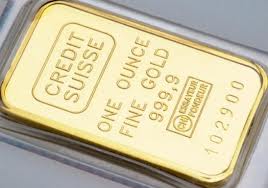
Gold Investments are traditionally considered a diversification of one’s asset portfolio and as protection from the risk of loss versus other investment options, although investing in gold can be a solid financial undertaking on its own. However, just like any financial decision, this calls for careful consideration and background checks to say the least. There are many options to invest in gold and as Forbes.com puts it, “Investing part of your portfolio in the yellow metal is one thing, deciding how is quite another.”

In the article “The Pros and Cons of Investing in Gold” by Marcie Geffner, she quotes Chris Hyzy, chief investment officer at U.S. Trust, the private wealth management arm of Bank of America in New York, saying “gold shouldn’t be considered an investment. Rather, the precious metal acts as a hedge, or a way to try to protect wealth against the risk of loss in such asset classes as real estate, equities and bonds.”

goldoz

Hyzy continues to explain that “it’s important to think like a central banker. The more growth comes from areas of the world that have high savings, the more (the price of) gold is likely to continue to rise because those savings need to be put to work in non-dollar instruments, including gold and other hard assets.”

On the other hand, the internet provides information regarding investing in the precious metal, for as long as you know how to assess proper and verified advice. Choosing to invest in or buy gold at BullionVault and in similar sites has become a choice of many investors. What should always be put in mind before going into such financial undertaking is to arm yourself with basic information and a background check of the firm you are dealing with, whether it be online or a “brick and mortar” establishment.

Marcie Geffner of BankRate.com highlights, “Gold prices can be quite volatile.” As Geffner quotes Frank Holmes, CEO and chief investment officer at U.S. Global Investors, a San Antonio-based investment fund, he says “70 percent of the time, it’s a ‘nonevent’ for the price of gold to rise or fall 15 percent in a 12-month period. In other words, investors can expect annual price swings of that magnitude or more much of the time. Gold stocks can experience even greater volatility than futures.”

On their website Consumer.FTC.com, The Federal Trade Commission (FTC), the nation’s consumer protection agency, says, “if you are interested in buying gold, do some digging before investing. Some gold promoters don’t deliver what they promise, and may push people into an investment that isn’t right for them.”

The FTC offers the types of gold investments that you can choose from as gold comes in a variety of forms:

  • Gold Stocks and Funds – It can either be buying into a mutual fund invested in physical bullion gold or an investment in a mining firm’s stocks. Forbes.com also offers this as one of four options in investing in gold. The FTC reminds, “Gold stocks and funds should only be purchased from licensed commodity brokers.”
  • Bullion and Bullion Coins – defined by the FTC as “a bulk quantity of precious metal, usually gold, platinum, or silver, assessed by weight and typically cast as ingots or bars.”
  • Collectible Coins – processed gold that have historic or aesthetic value. FTC notes, “Most collectible coins have a market value that exceeds their face value or their metal content. This collectible value is often called numismatic value. The coin dealers who sell collectible coins often have valuable coins graded by professional services, but grading can be subjective.”

The Consumer Protection Agency also provides for constant facts about gold that you would need to know:
1. Gold prices fluctuate. There are no assurances that values will increase or just be maintained.
2. “The prices coin dealers, banks, brokerage firms, and precious metals dealers charge for gold products, like bullion and coins, are almost always higher than the value of the gold the products contain,” FTC advises. Compare prices.
3. There is no existing federal law or Treasury Department regulation ordering any type of confiscation of gold.

In any endeavor, always do your research. FTC puts it simply, “Investigate Before You Invest”.

{ 0 comments }

Frontline – The Retirement Gamble

Last February, I asked the question – Are you 401(k)o’ed? I was concerned that my readers might not have been aware of the fees they were paying inside their 401(k) retirement accounts. It seems that this topic has hit the mainstream media, and recently, PBS’ Frontline ran their story The Retirement Gamble which you can see on line if you missed it.

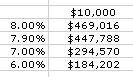
The message is simple, over time, fees will destroy your returns. Over a lifetime of investing the difference between a .1% cost and a 2% cost is insane.

stockreturn

Jack Bogle, the father of index investing, is interviewed and discussed these numbers, how the market might grow your $10,000 to over $45,000 over 50 years at 8%, but a 2% per year cost will confiscate nearly 2/3 of your returns. Unfortunately, Jack misspoke when he said, “Get Wall Street out of the equation. Get trading out of the equation. Get management fees out of the equation. You own American business and you hold it forever. That’s what indexing is. Own a fund that owns the entire U.S. stock market, does no trading, and has a cost of 1 percent a year to own. And that is the only way to do it. Then you’re with a creature of the market and not of the casino.” Even 1% isn’t great, you’d still lose 1/3 of your money over the five decades in his example. A tenth of a percent is more like it. Over the years, there’s still a $20,000 loss to fees, but we’re talking 50 years in the example. The quote got it right, but I think Jack meant to say a tenth percent.

It was decades ago that Jack Bogle promoted the concept of indexing and founded Vanguard’s Indexed Mutual Funds long before ETFs were invented. Anyone who has any background in finance and investing would be aware of Bogle, Vanguard, and Bogle’s thesis that managed funds can’t add enough value to exceed their high costs.

Everyone except for Christine Marcks, President, Prudential Retirement who responded with, “Yeah, I haven’t seen any research that substantiates that. I mean, it— I don’t know whether it’s true or not. I honestly have not seen any research that substantiates that.” The interviewer asked if she’d seen the research Vanguard had done on the topic and she replied, “No, I haven’t. I haven’t— I haven’t read everything. But so much of it depends on, you know, what I need is different than what you need and there’s not an asset allocation or a fund strategy that’s right for everybody.”

One last quote from Jason Zweig of the Wall Street Journal, “And one of the ultimate dirty secrets of the fund industry is that a lot of people who run other fund companies own index funds in their— in their own accounts and don’t talk about it, I mean, unless you put a couple beers in them.” I suspected that, myself.

To be fair, not all 401(k) funds have such high expenses, the S&P fund in my own 401(k) is .06%, less than a 3% hit over 50 years. Frontline also missed, or ignored, any discussion of matched funds. My own advice is when your company offers a dollar for dollar match, you should grab it. The decades pass quickly and you’ll look back at a high six figure account and see how nearly half the money came from your employer instead of from your wallet.

Check out the show and let me know, did you feel it was balanced? Was I too tough on Christine Marcks? Have you check the fees inside your own 401(k)?

{ 9 comments }